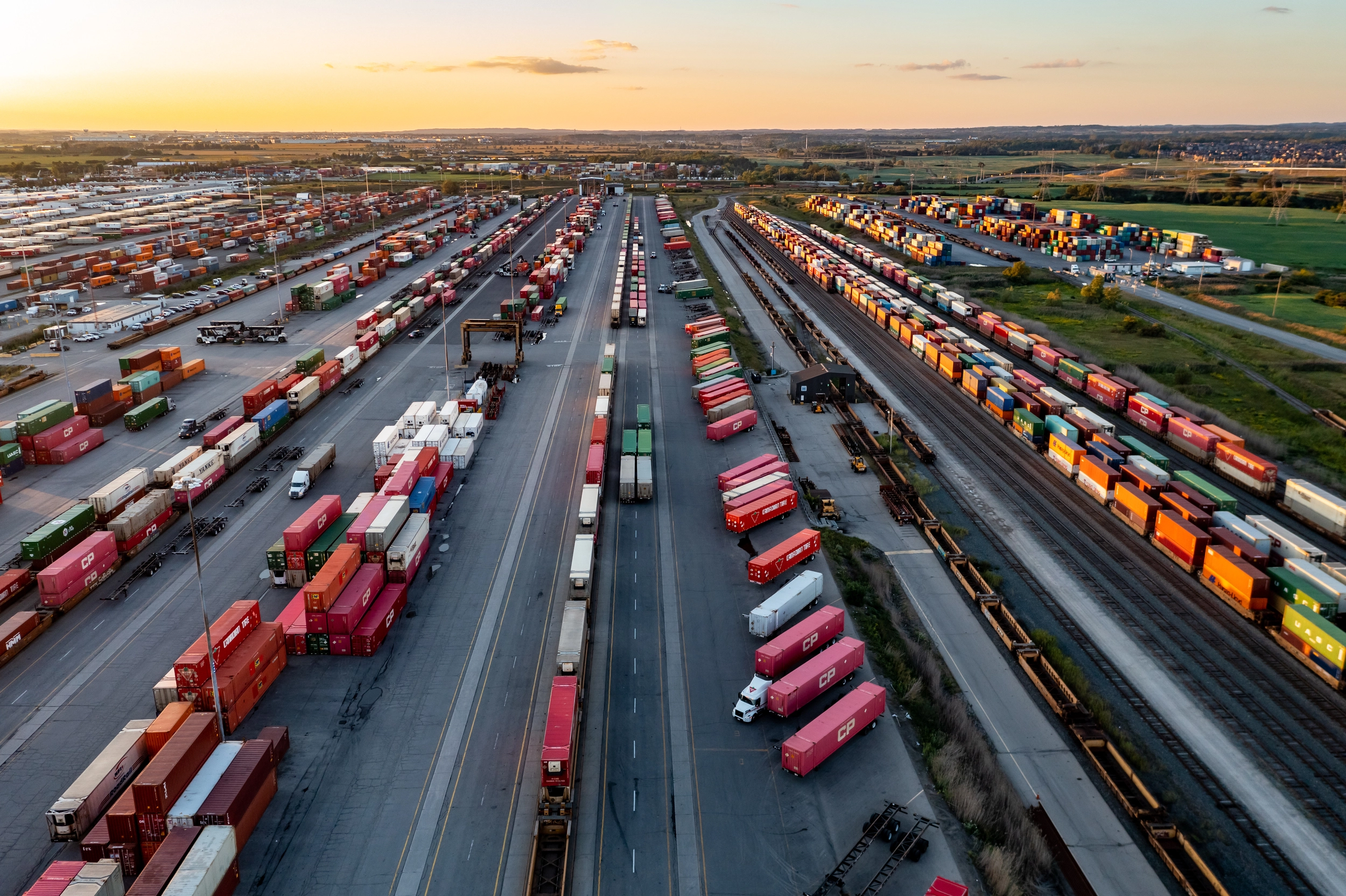


The Port of Hamburg is the largest rail port in Europe. In 2024, rail moved more than 2.6 million TEU through the port — accounting for over 50% of all container transport in the modal split — handled by approximately 200 freight trains and 5,500 railcars every single day. More than 160 rail operating companies converge here, connecting terminals in Hamburg to destinations in China, Poland, Austria, and across the European intermodal network.
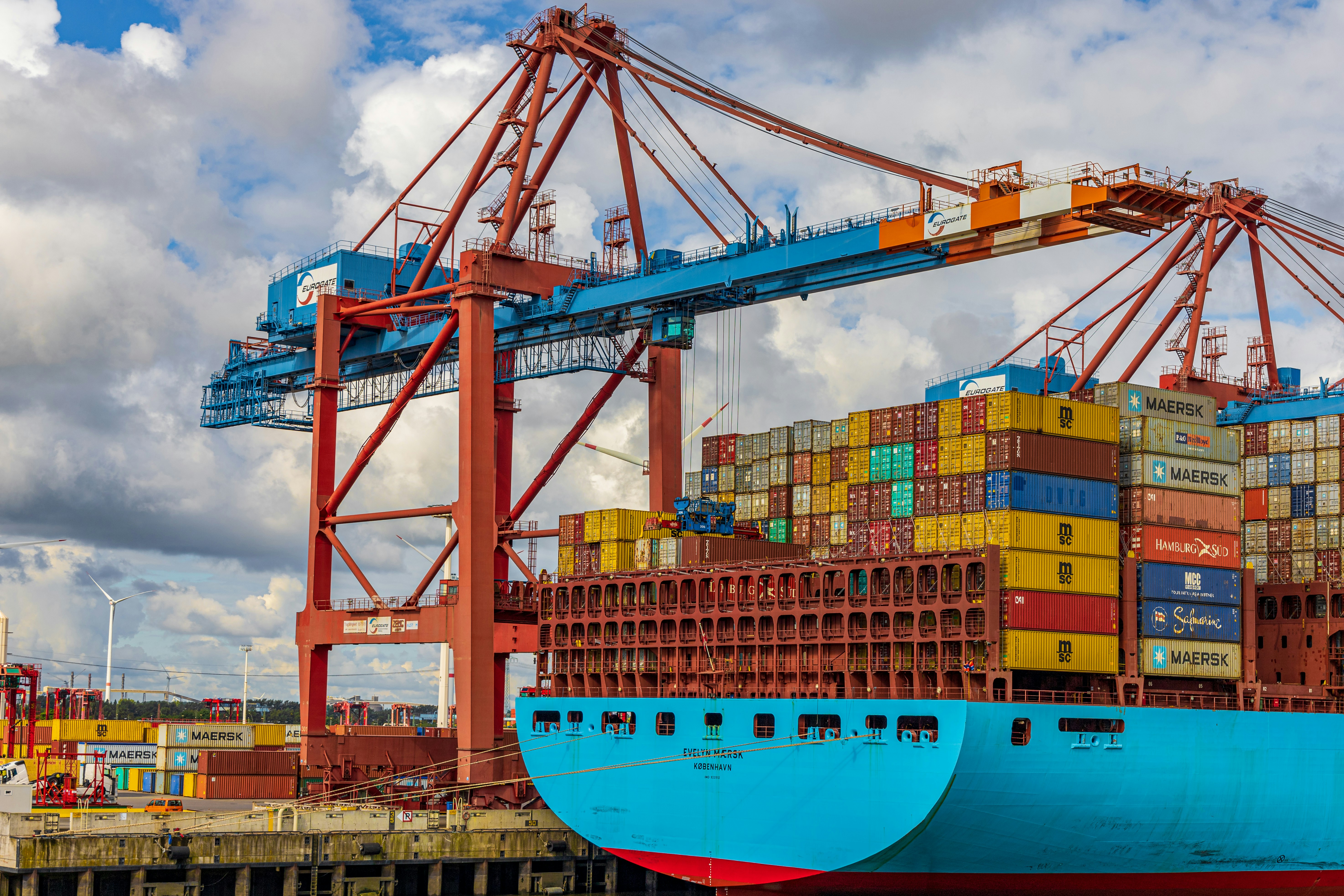
And yet, for all that complexity — sea arrivals, rail departures, road interfaces, gate flows, yard movements, crane cycles — the coordination challenge at the terminal level is still largely the same as it was a decade ago. Terminal operating systems (TOS), fleet management systems (FMS), yard management systems (YMS), and ERP platforms run in parallel but don't share a decision framework. Dispatchers fill the gap with experience, radio calls, and reactive judgment.
That gap is what ReeWell, developed by Westwell, is built to close. ReeWell is an AI World Model-driven intelligent scheduling and fleet management platform — the operational brain of the logistics site itself. It ingests every data stream from vessels, gates, cranes, vehicles, and energy systems; builds a live physical model of the entire terminal; and dispatches coordinated scheduling decisions in milliseconds, automatically.
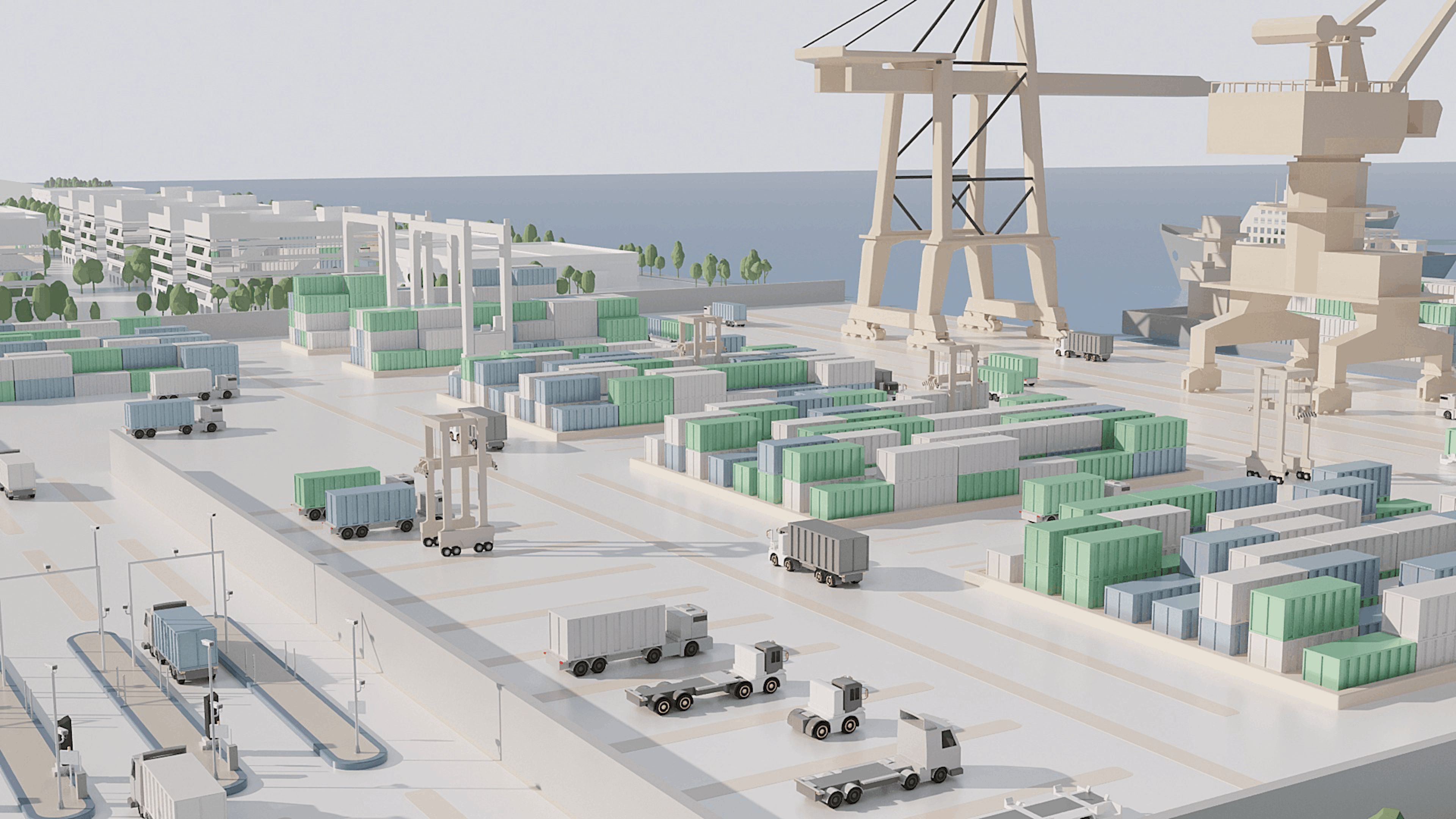
At TOC Europe 2026 in Hamburg (May 19–21), Westwell presented the latest iteration of ReeWell — a platform that has already demonstrated a increase in core terminal equipment efficiency,and increase in yard throughput, and reduction in energy consumption across live commercial deployments at global ports.
The operational pressure at major container terminals today comes from three converging forces.
First, intermodal complexity is increasing. Ports like Hamburg aren't just sea-to-truck interfaces anymore. They are multimodal hubs where sea arrivals trigger rail departures, rail arrivals feed yard staging, and yard positions determine gate release sequences. Each handoff is a coordination event. Each delay compounds.
Second, equipment fleets are becoming mixed. Autonomous terminal tractors, manned electric trucks, AGVs, and legacy diesel equipment increasingly operate in the same terminal simultaneously. No conventional FMS was designed to coordinate all of them as a unified fleet.
Third, data exists but isn't unified. Most terminals have invested heavily in TOS, WMS, gate automation, and sensor infrastructure. The data is there — but it's fragmented across systems that don't share a common clock or a common decision logic.
ReeWell doesn't add another layer of software to this fragmentation. It replaces the coordination gap itself.
An AI World Model in port logistics is a continuously updated, physics-aware simulation of an entire terminal site — including all vessels, vehicles, cranes, yard positions, gate queues, and energy systems — that an AI uses to predict future operational states and generate optimized scheduling decisions in real time.
Unlike rule-based container terminal scheduling systems that respond to events after they occur, an AI World Model anticipates disruptions before they cascade. ReeWell's world model — called Hymala — maintains a live 3D digital representation of the site, predicts congestion, equipment failure, and vessel delays up to 24 hours ahead, and feeds that foresight directly into the scheduling engine.
The result is a port terminal automation software platform that doesn't just monitor operations — it programs them.
ReeWell's technical differentiation comes from four integrated layers operating as a single system:
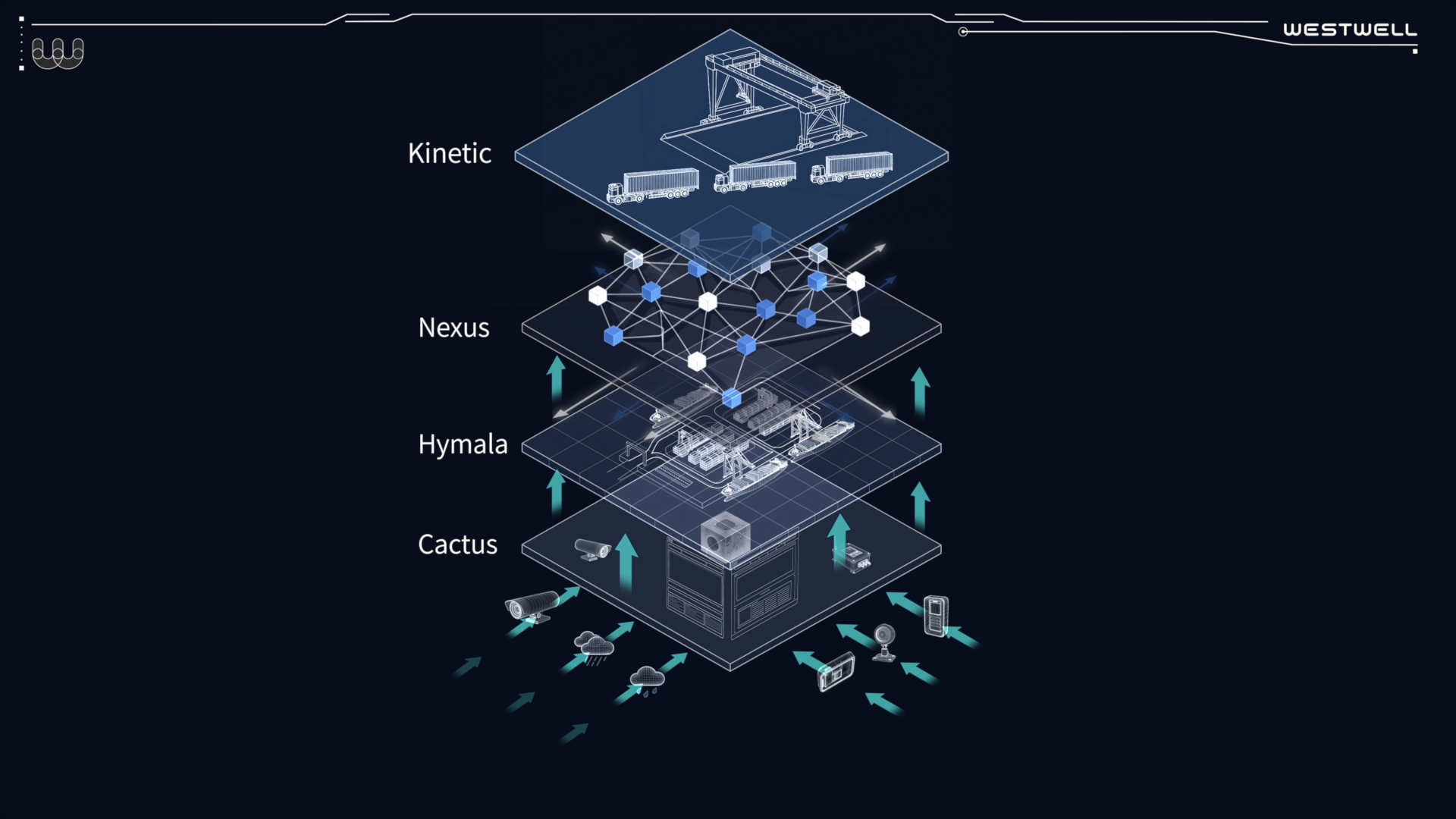
| Layer | Name | What It Does |
| L1 | Cactus Data Foundation | Unifies all site data — vessel schedules, gate events, crane cycles, energy systems, HD maps, and sensor feeds — into one governed data layer. Eliminates the "TOS says arrived, FMS says dispatched" coordination mismatch that forces manual dispatcher intervention. |
| L2 | Hymala World Model & Digital Sandbox | Builds a live, physics-aware 3D model of the entire terminal. Predicts what will happen 24 hours ahead. Detects congestion, equipment failures, and vessel delays before they cause operational disruption. |
| L3 | Nexus Agent Decision Engine | The scheduling brain. Combines two AI engines — Multi-Agent Reinforcement Learning (MARL) for dynamic efficiency optimization and Operations Research (OR) algorithms for hard-constraint safety — to output millisecond rescheduling decisions. |
| L4 | Kinetic Autonomous Execution | Converts decisions into physical commands. Instructions reach autonomous vehicles and equipment in under 50 milliseconds. |
This architecture delivers what no point-solution TOS or standalone FMS can: transparent, structured, and programmable logistics flow — across every zone, every asset class, and every shift.
ReeWell is a modular platform. Each product can be deployed independently or as an integrated suite — making it accessible whether a terminal is beginning with fleet management or deploying full-site AI orchestration.
| Product | Category | Core Function |
| WellFMS | Fleet Management System | Centralized dispatch and real-time monitoring for all horizontal transport equipment — autonomous and manned, mixed fleets |
| WellScheduler | AI Scheduling Engine | Dual-engine AI scheduling for vehicles, cranes, and assets across automated, semi-automated, and manual operating modes |
| WellSimtec | Digital Twin Platform | Full-link AI simulation — validates throughput, energy, and capacity scenarios before any physical deployment or configuration change |
| WellRCMS | Resource & Crane Management | Task allocation and dispatch for non-vehicle equipment including quay cranes (STS) and yard cranes (RTG/RMG), with integrated energy balancing |
| WellYMS | Yard Management System | AI-driven inbound and outbound orchestration connecting autonomous vehicles, manned trucks, and Wellbot fleets into a single yard flow |
| WellEMS | Energy & Carbon Management | Integrates electricity, oil, gas, and water/steam consumption with demand response and grid services for site-wide carbon and cost management |
ReeWell launches silently alongside existing TOS and FMS platforms. In Shadow Mode, the system computes scheduling decisions in read-only mode, compares its outputs against current dispatching outcomes, and activates live control only when efficiency improvement exceeds a 30% confidence threshold. No rip-and-replace. No cutover risk. The terminal keeps running while ReeWell learns.
Unlike static container terminal scheduling systems that perform identically on day one and day 1,000, ReeWell learns from every operation. Shadow Mode captures top dispatcher decisions as training data. Edge cases from weather events, equipment failures, and unplanned vessel arrivals feed model updates automatically. Manual intervention rates drop as system intelligence compounds — a self-reinforcing performance moat that rule-based software cannot replicate.
Using the Cactus data layer and the Hymala physical simulation, ReeWell projects energy costs, equipment depreciation, throughput impact, and labor savings before any physical deployment. Terminal operators receive simulation-backed ROI projections — not spreadsheet assumptions — giving procurement teams defensible numbers at every approval stage.
A real-time dual-screen dashboard surfaces all zones, equipment, vessels, and energy facilities simultaneously. Traffic heatmaps identify congestion risk across the yard. Task distribution maps flag workload imbalance. Exceptions surface automatically. Dispatchers investigate by clicking — not by calling. This is the operational visibility layer that yard management software deployments have historically failed to deliver across mixed asset fleets.
The same scheduling logic that coordinates autonomous container trucks at a seaport also manages air cargo Unit Load Devices (ULDs) at airports, wire harness racks at automotive factories, and steel coils at industrial mills. One platform architecture. Unlimited vertical expansion.
Laem Chabang Port, Thailand — World-leading Mixed-Fleet Scheduling at Scale
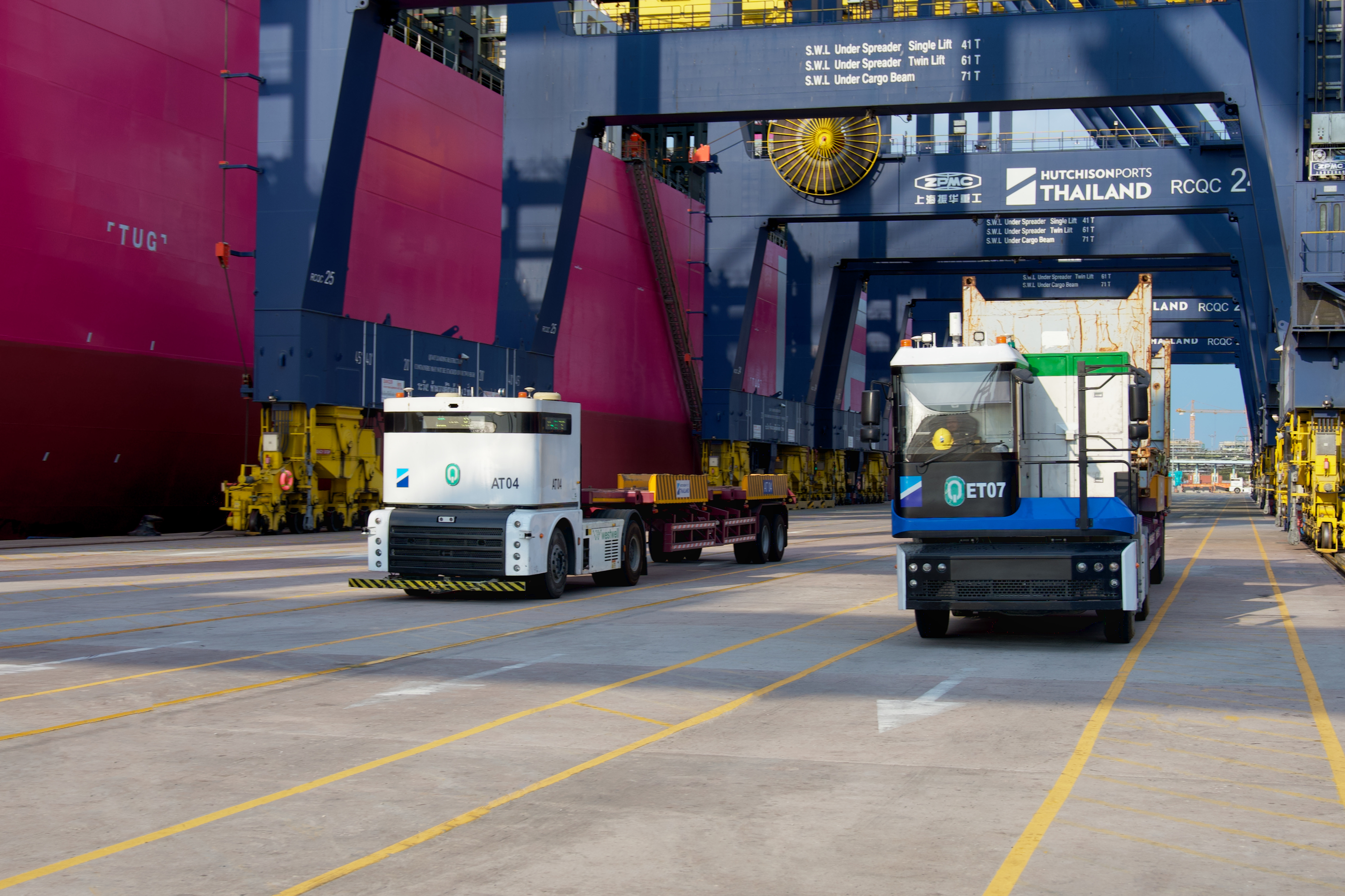
Thailand's Laem Chabang Port is one of Southeast Asia's busiest container hubs. Westwell deployed a fully integrated stack including Q-Truck autonomous terminal tractors, E-Truck intelligent electric trucks, WellFMS fleet management, smart gate systems, and PowerOnair battery swap infrastructure.
The deployment achieved a 30% operational efficiency uplift through continuous 24/7 vessel-side operations enabled by mixed human-and-autonomous fleet coordination. More than 750,000 TEUs have been processed as of 2025. Each Q-Truck delivers up to 50 tonnes of CO₂ reduction per vehicle annually under green electricity scenarios.
Critically, this became the world's one of the leading scalable mixed-operation models — allowing autonomous and human-driven trucks to operate in the same terminal without magnetic pins or physical isolation, significantly reducing transformation cost and complexity for the operator.
| Capability | Conventional TOS / Standalone FMS | ReeWell AI World Model Platform |
| Data integration | Point-to-point API connections, system-siloed | Unified data layer (Cactus) across TOS, WMS, FMS, OT systems |
| Scheduling logic | Rule-based or static optimization | MARL + OR dual-engine AI, millisecond rescheduling |
| Predictive capability | Reactive (post-event alerts) | 24-hour ahead prediction via Hymala World Model |
| Mixed fleet coordination | Single asset class per system | Autonomous vehicles, manned trucks, cranes, and energy — unified |
| Deployment risk | Requires cutover; operational exposure | Shadow Mode — zero disruption, parallel validation |
| Learning capability | Static; performance fixed at go-live | Self-improving from live operational data continuously |
| ROI visibility | Post-implementation measurement only | Simulation-backed projection before commitment |
ReeWell is an AI World Model-driven, full-scene intelligent scheduling and fleet management platform developed by Westwell Lab Inc. It serves as the operational brain for complex logistics sites — replacing fragmented, radio-dependent coordination with a continuously learning AI that sees every asset, predicts every bottleneck, and dispatches decisions in milliseconds.
A traditional fleet management system (FMS) tracks vehicle location and task status within a single asset class. ReeWell builds a live physical model of the entire site using an AI World Model, runs 24-hour predictive simulations, and coordinates vehicles together with cranes, energy systems, and yard infrastructure in a single unified decision loop — while continuously improving dispatch efficiency through operational learning.
Yes. The Cactus Data Foundation unifies data from existing terminal operating systems (TOS), warehouse management systems (WMS), ERP platforms, and operational technology (OT) systems without requiring replacement. ReeWell operates as the coordination and intelligence layer above existing infrastructure.
Shadow Mode is ReeWell's zero-disruption onboarding protocol. The platform runs alongside existing systems in read-only mode, computing scheduling decisions in parallel without executing them. It activates live control only when it can demonstrate a 30% efficiency confidence improvement. This eliminates the operational risk that has historically made port operators cautious about replacing core scheduling systems.
ReeWell is designed to coordinate any logistics asset. It was developed in parallel with Westwell's autonomous vehicle product line — Q-Truck (cabless autonomous terminal tractor) and E-Truck (L4-upgradable smart electric truck) are both natively orchestrated through WellFMS. This creates a complete autonomous logistics infrastructure stack: vehicles that move cargo, energy infrastructure that keeps them moving, and ReeWell making every decision smarter across all of it simultaneously.
For terminals at any logistics hub evaluating standalone port scheduling software, an AI fleet management system, or full-site intelligent logistics infrastructure — ReeWell delivers each as a modular entry point into the same underlying AI World Model architecture.
The Port of Hamburg processes over 7.8 million TEU per year, with rail accounting for more than half of all container transport. That level of intermodal complexity — sea arrivals triggering rail departures, yard moves cascading into gate sequences, mixed autonomous-and-manned fleets operating shift after shift — is exactly the coordination challenge that legacy point solutions cannot solve alone.
ReeWell is built for precisely this scale. Not as a monitoring dashboard. Not as a standalone FMS. As the intelligent scheduling layer that programs the entire flow.