


Products
Industries
LinkAige
About


In the high-stakes world of air cargo logistics, speed defines competitiveness—but it’s not the only variable that matters. As airport cargo hubs accelerate the deployment of AS/RS systems and AI-driven sorting technologies, many are discovering that automation alone doesn’t guarantee performance gains.
Instead, a growing number of terminals are falling into what can be described as an “automation black box”—where capital investment is high, but operational visibility and measurable ROI remain unclear. Industry research consistently shows that automation projects often deliver lower-than-expected cost savings, and in some cases even increase per-unit handling costs due to integration complexity, fragmented data flows, and inconsistent operational conditions.
The problem? Many cargo warehouse managers treat automation as a trophy rather than a tool. If your cargo hub automation strategy results in robots that only run during VIP tours or systems that require a small army of manual workers to "fix" errors, you have a vanity project, not an operational win.
True cargo handling efficiency isn't measured by how many robots you own, but by the bottom line. To help you figure out how to measure air cargo automation ROI, we’ve identified the five essential KPIs for cargo warehouse automation. These air cargo automation performance metrics are the only way to ensure your tech is actually reducing cargo dwell time in airports and building a sustainable future.
In air cargo logistics, speed is the only currency. If your cargo is still sitting idle in a cargo warehouse for 48 hours after you’ve deployed an AS/RS in air cargo or AI cargo sorting systems, the tech isn’t working—it’s just moving the bottleneck.
True cargo handling efficiency isn't about how fast a single robot runs; it's about the "Total Dwell Time." We define this as the full-chain closed-loop: from the moment the aircraft's wheels touch the tarmac until the cargo is cleared, sorted, and ready for final dispatch.
High CDT doesn't just hurt your timeline; it bleeds your budget. Every hour a pallet sits idle is an hour of "ghost energy"—continuous costs for climate control, lighting, and security. For pharmaceutical or cold-chain airport cargo, these costs don't just add up; they explode.
The logic is simple: Shorter dwell times equal lower energy intensity per ton. By accelerating throughput, you increase your asset turnover, allowing your existing cargo terminal automation to handle more volume without expanding your physical footprint or carbon overhead.
Unlocking CDT reduction requires moving beyond isolated automation toward a synchronized, end-to-end cargo flow strategy. The goal is not faster machines—but fewer delays between them.
Dwell time often accumulates not inside systems, but between them—on the apron, in staging zones, and during handoffs.
By combining Westwell ReeWell AI-driven dispatching platform with a centralized Fleet Management System (FMS), terminals can transform tow tractor operations from reactive to fully synchronized:
-On-demand dispatching eliminates manual queuing and idle waiting time
-Dynamic task allocation ensures tractors are assigned based on real-time cargo priority and flight schedules
-Continuous routing enables seamless movement between aircraft, warehouse, and landside without interruption
-Fleet-wide coordination removes bottlenecks caused by unbalanced utilization or empty runs
Instead of operating as isolated transport units, tow tractors become part of a continuous flow system—directly compressing transfer delays and reducing overall cargo dwell time.
A centralized control layer provides:
-an all-in-one operational dashboard integrating energy systems, ULD tracking, fleet status, and warehouse equipment
-real-time coordination between AS/RS, sorting systems, and ground vehicles
-proactive identification of bottlenecks before they impact throughput
By aligning every subsystem on one screen—and one logic—you eliminate the “automation black box” and turn dwell time reduction into a measurable, controllable outcome.
Automation doesn’t start with a robot—it starts with a data point. In air cargo logistics, even minor data inconsistencies can cascade into system-wide failures. As IBM estimates, poor data quality costs organizations trillions annually—highlighting how foundational accurate data is to operational performance.
Yet many cargo terminals remain constrained by fragmented data flows. According to International Air Transport Association, the lack of standardized and high-quality data exchange continues to be a key barrier to automation in air cargo. At the same time, industry reports from DHL show that manual data handling and exception management still play a significant role in day-to-day logistics operations.
The result is a system where automation exists—but cannot operate cleanly. AI cargo sorting systems and ASRS are forced to handle constant exceptions: mis-sorts, failed task execution, and manual overrides. In this environment, the real performance metric is not system deployment, but First-Pass Yield (FPY)—the percentage of cargo and data that moves through the system correctly, without rework.
Many cargo terminal automation projects fail because they ignore the digital foundation. If you need a team of humans to "fix" electronic files before the robots can read them, you haven't automated—you’ve just moved the paperwork to a screen.
-High FPY: Data flows from booking to takeoff without a single human keystroke. The system runs at 100% designed capacity.
-Low FPY: Humans become the "bridge" between disconnected systems, killing the ROI of your cargo hub automation strategy.
Achieving high FPY requires more than just a digital file; it requires an integrated warehousing solution that acts as the single source of truth for every robot, tractor, and sensor in the hub.
-The Digital Conductor: Westwell’s software ecosystem serves as the bridge between high-level flight data and floor-level execution. It ingests standardized data from external partners and translates it into flawless, real-time "tasks" for your hardware.
-Unified Intelligence: By unifying data across the cargo warehouse, the system ensures that when an AS/RS in air cargo or an AI cargo sorting system receives an instruction, it is "first-time right." There is no guesswork for the machine and no manual correction for the staff.
-The Result: We move from "reactive fixing" to "predictive execution." When data is unified, your airport cargo operations become a seamless loop where the digital plan and the physical movement are perfectly synchronized.
There is a massive misconception in air cargo logistics: that the value of automation is simply "cutting headcount." In reality, the goal is scalability.
If your airport cargo hub relies on massive waves of temporary hiring every time there’s an e-commerce peak or a holiday rush, your operation isn't sustainable—it's reactive. Labor Hours per Tonne (LHT) measures how much human effort is required to move one unit of cargo.
-The Math: (Total Manual Working Hours) / (Total Tonnage Handled).
-The Goal: A consistent downward trend. As you deploy cargo hub automation strategy, you should be able to handle more volume without a linear increase in man-hours.
Ground handling is notorious for high injury rates and exhausting turnover. From a social sustainability perspective, cargo terminal automation is a moral imperative. By letting machines handle the "Three D’s"—Dull, Dirty, and Dangerous—you protect your most valuable asset: your people.
-Reduced Wear & Tear: Automating heavy lifting in the cargo warehouse slashes work-injury rates and muscle strain.
-Stability over Stress: Instead of burnout-inducing overtime during peaks, your team shifts to "Value-Add" roles—monitoring systems, handling exceptions, and optimizing the air cargo automation performance metrics.
-Talent Retention: When you upgrade a manual laborer to a "System Operator," you aren't just improving efficiency; you're building a stable, long-term career path.
When LHT is optimized, your cargo handling efficiency becomes "elastic." You no longer fear the peak season because your airport cargo infrastructure can breathe.
-The Westwell Edge: By integrating autonomous tow tractors like the Q-Tractor or automated palletizing solutions, you remove the physical bottlenecks that drive LHT up.
-The Positive Loop: As humans are liberated from repetitive tasks, they have the bandwidth to focus on process iteration. They become the "brains" of the operation, finding new ways to reduce energy costs or refine the dispatch flow.
You’re building a healthy, stable operation model that can scale to global demands without breaking your workforce.
In the push for cargo terminal automation, there is a dangerous myth: Automation is naturally green. The reality? Running an AS/RS in air cargo or a fleet of robots 24/7 can cause total energy consumption to skyrocket. If your efficiency goes up but your carbon footprint and energy costs double, you’ve failed the sustainability test.
With IATA’s commitment to Net Zero by 2050, energy efficiency is no longer optional for air cargo logistics. We measure this through Energy Intensity: the exact amount of electricity (kWh) required to move one kilogram or pallet of cargo. This metric strips away the "noise" of cargo volume and tells you how efficient your tech actually is.
To drive down Energy Intensity per Unit (KPI 4), a cargo warehouse needs more than just electric machines; it needs a conductor. The Westwell EMS acts as the central nervous system for the terminal’s power grid, moving beyond simple monitoring to active, AI-driven optimization.
-Peak-Shaving Intelligence: The EMS doesn't just watch the meter. It uses AI algorithms to cross-reference your airport cargo flight schedules with real-time utility pricing. It automatically schedules high-drain tasks—like bulk charging or heavy ACS/RS in air cargo movements—during "valley" price windows, slashing operational costs without touching the brake.
-Virtual Twin of Energy Flow: By visualizing the entire energy lifecycle, from the rooftop solar panels to the battery in a terminal tractor, the EMS identifies "energy leaks." If a sorting line is idling during a low-volume window, the EMS flags it, ensuring that air cargo throughput is always achieved at the lowest possible carbon cost.
In a 24/7 air cargo logistics environment, downtime isn't just an inconvenience—it’s a disaster. If a manual worker is out, you lose one pair of hands. If your AI cargo sorting systems or ACS/RS in air cargo go offline, your entire airport cargo operation grinds to a halt.
We measure this through two critical lenses:
-System Availability: The percentage of time your system is actually ready to work. (A 1% drop equals 7+ hours of lost movement per month).
-MTBF (Mean Time Between Failures): The average time the system runs before a hiccup. If your engineers are "babysitting" the tech 24/7, your ROI is being eaten by maintenance costs.
Many cargo terminal automation projects fail not during the launch, but in the years that follow. Without a dedicated support ecosystem, high-speed hardware eventually succumbs to the "grind" of daily operations, leading to frequent jams, part failures, and eroded profit margins.
True sustainability is built on the full lifecycle of the equipment. Westwell’s WeWell Service ensures that your cargo hub automation strategy doesn't just look good on Day 1, but stays optimized for a decade.
-Predictive Health Orchestration: WeWell doesn't wait for a breakdown. By integrating with the existing platforms or systems, our service team monitors the "Digital Pulse" of your cargo warehouse in real-time. We identify wear-and-tear patterns and schedule "Preventative Pit-Stops" during low-volume windows, ensuring the system is always ready for the next peak.
-On-Site & Remote Synergy: WeWell combines the precision of remote AI diagnostics with the speed of expert on-site support. By standardizing spare parts and simplifying modular repairs, we drastically reduce the time it takes to get back online.
-Lifecycle Evolution: Automation shouldn't be static. The WeWell Service includes continuous optimization—updating algorithms and refining workflows as your airport cargo volume grows.
Truly successful automation isn't about how many robots you own; it’s about how seamlessly they integrate into your most complex environments. A prime example of this is Westwell Technology’s 2025 partnership with Hong Kong International Airport (HKIA)—the world's leading cargo airport.
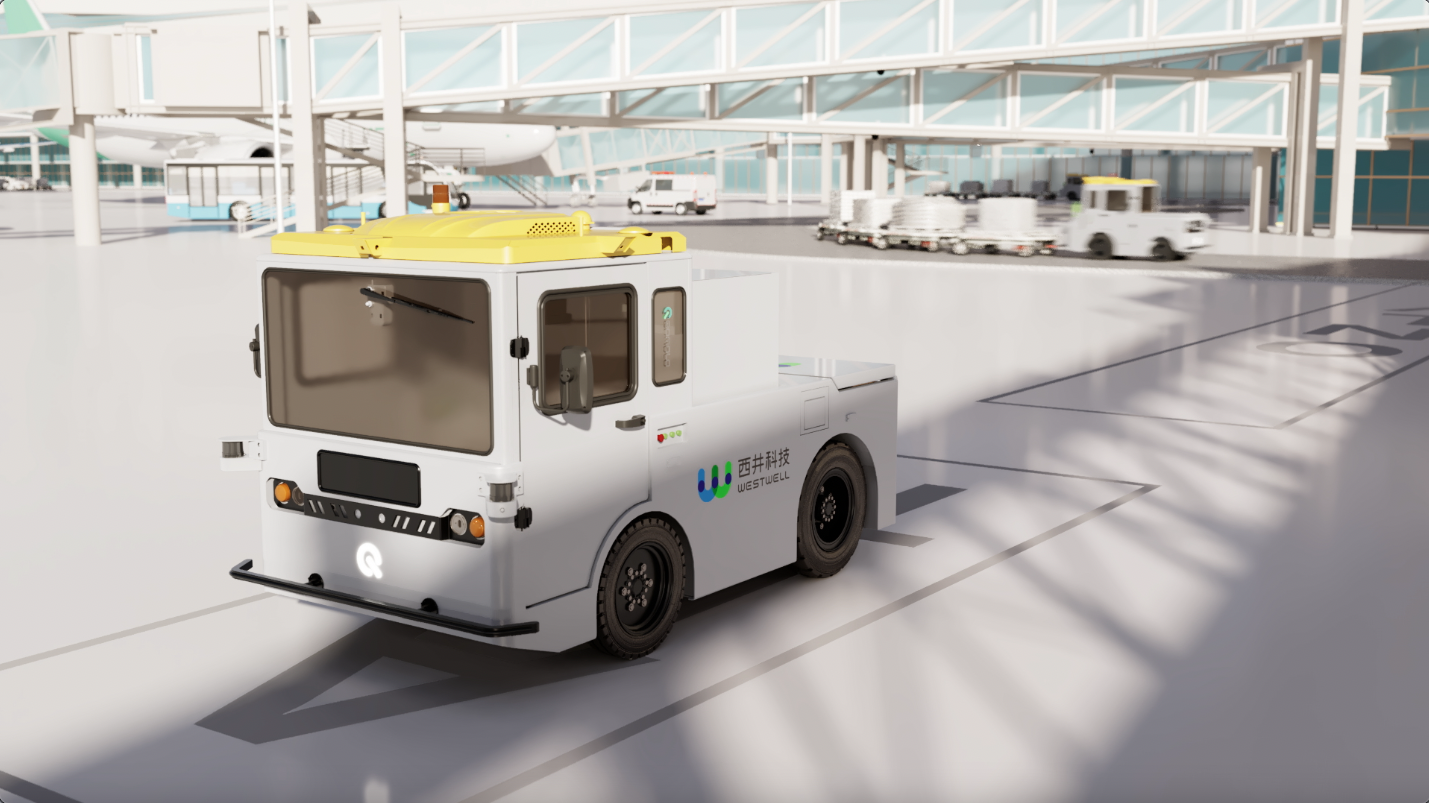
To elevate their ground operations, a fleet of Westwell’s Q-Tractor autonomous tow tractors will be deployed at HKIA. Purpose-built for the high-stakes aviation environment, these L4 autonomous vehicles possess a deep understanding of complex, multi-zone operational rules, allowing them to navigate and operate with absolute stability amidst the dynamic, constantly shifting reality of the tarmac.
Beyond sheer driverless capability, the Q-Tractor is powered by a robust intelligent interconnection system that guarantees full-process visibility, management, and control. This software-hardware synergy is further enhanced by the vehicle's automated towing and hitching technology. By executing seamless, completely unmanned docking and uncoupling with cargo trailers, the Q-Tractor drastically shortens waiting times at loading bays and maximizes the turnaround efficiency of every single vehicle in the fleet.
This level of technological synergy is what "Actually Working" looks like. To achieve similar results and avoid the automation "black box," operators must track the right data. We have identified five critical air cargo automation performance metrics that separate high-tech vanity from true operational scalability.
Cargo terminal automation is not a one-off project—it’s a continuous optimization journey. The five KPIs we propose are more than metrics; they form the framework for a future-proof cargo hub automation strategy and break the automation “black box,” making every investment in ASRS, AI sorting, and other systems measurable and optimizable.
Logistics hubs should audit their systems against these KPIs: Are dwell times shrinking? Is data entry accurate? Is labor efficiency improving? Is energy intensity declining? Is the system operation stable? These questions reveal whether automation creates real operational value or is just high-tech vanity.
Crucially, KPIs must be visible on the front line in real time, empowering supervisors and dispatchers to identify bottlenecks, adjust operations, and solve problems immediately. By anchoring operations to these KPIs, cargo automation shifts from “available or not” to truly effective, delivering both short-term efficiency and long-term sustainable value.