


Products
Industries
LinkAige
About


The container port industry is facing one of the most consequential transformations in its history. As regulators, cargo owners, and investors align on decarbonization targets, terminal operators are being asked to do something unprecedented: cut emissions substantially while simultaneously increasing throughput. The challenge is not philosophical — it is operational and architectural.
A zero-carbon port is not achieved through a single technology purchase. It requires redesigning how energy flows, how vehicles move, and how decisions are made — simultaneously, at scale. This article explains why that redesign must happen now, what the regulatory and commercial pressures look like in 2026, and how Westwell has engineered the Ainergy strategy to make intelligent green port transformation practically achievable.
For years, "green port" was a directional ambition. In 2026, it is a compliance imperative backed by binding international policy.
According to the International Maritime Organization (IMO), the 2023 IMO GHG Strategy targets net-zero greenhouse gas emissions from international shipping by or around 2050, With indicative checkpoints requiring at least 20–30% reduction in total annual GHG emissions by 2030 compared to 2008 baseline levels. Carbon intensity reduction targets — measured via the Carbon Intensity Indicator (CII) — require at least 40% improvement by 2030. For ports and terminals operating within EU jurisdiction, the stakes are even more immediate: the EU Emissions Trading System (EU ETS) was extended to cover maritime emissions from January 2024, and from 2026 onward, 100% of reported emissions must be covered by purchased allowances, according to the European Commission.
The IMO's Net-Zero Framework — approved in draft by MEPC 83 in April 2025 and under active negotiation for adoption — proposes binding greenhouse gas fuel intensity reduction targets for ships over 5,000 gross tonnage, a category that accounts for approximately 85% of total international shipping emissions, according to the Global Maritime Forum (2025). Should the framework be formally adopted, it would make international shipping the first global industry subject to mandatory, binding, economy-wide emissions reductions.
Ports are not incidental to this transition. They are the bottleneck. Container dwell time, crane operations, horizontal transport, and gate management collectively represent the most energy-intensive, labor-intensive, and emissions-intensive phases of the global supply chain. Transforming the port is where the decarbonization curve bends.
According to UNCTAD, shipping accounts for close to 3% of global greenhouse gas emissions — a figure that underscores how central maritime logistics is to any credible climate strategy. The pressure now falls directly on terminal operators to demonstrate that high throughput and low emissions are not competing objectives.
Most ports attempting decarbonization today face a fragmentation problem. They have acquired electric equipment here, a fleet management system there, and perhaps a sustainability reporting tool bolted on top. The result is a patchwork of solutions that cannot coordinate with one another — and that cannot deliver the integrated autonomous port logistics that genuine zero-carbon transformation requires.
This fragmentation creates three structural barriers to zero-carbon port operations:
Energy blind spots. When charging infrastructure, vehicle dispatch, and crane operations are managed by separate systems, energy demand peaks are unpredictable, charging queues accumulate, and demand response becomes impossible. The port cannot optimize what it cannot see holistically.
Efficiency gaps between systems. Semi-autonomous vehicles operating without coordinated scheduling produce the same congestion and idle time as manual fleets — just with a different driver profile. Without site-wide orchestration, automation hardware delivers a fraction of its designed efficiency.
Inability to predict and pre-empt. Traditional port management systems are reactive: they respond to conditions after they occur. A zero-carbon port requires predictive energy management and autonomous task scheduling that anticipates load, adjusts routes, and balances resources before problems materialize.
These are not software problems. They are architecture problems. Solving them requires rethinking the entire operational stack — from the vehicle on the ground to the intelligence layer above it.
Westwell developed the Ainergy Strategy as a response to this architecture problem. The name reflects its foundation: AI intelligence combined with new energy systems, deployed as an integrated solution rather than a collection of independent tools. In practice, Ainergy is Westwell's answer to what green port automation requires at the systems level — not individual electric vehicles or standalone software, but a coordinated platform in which hardware, scheduling, and energy management operate as one.
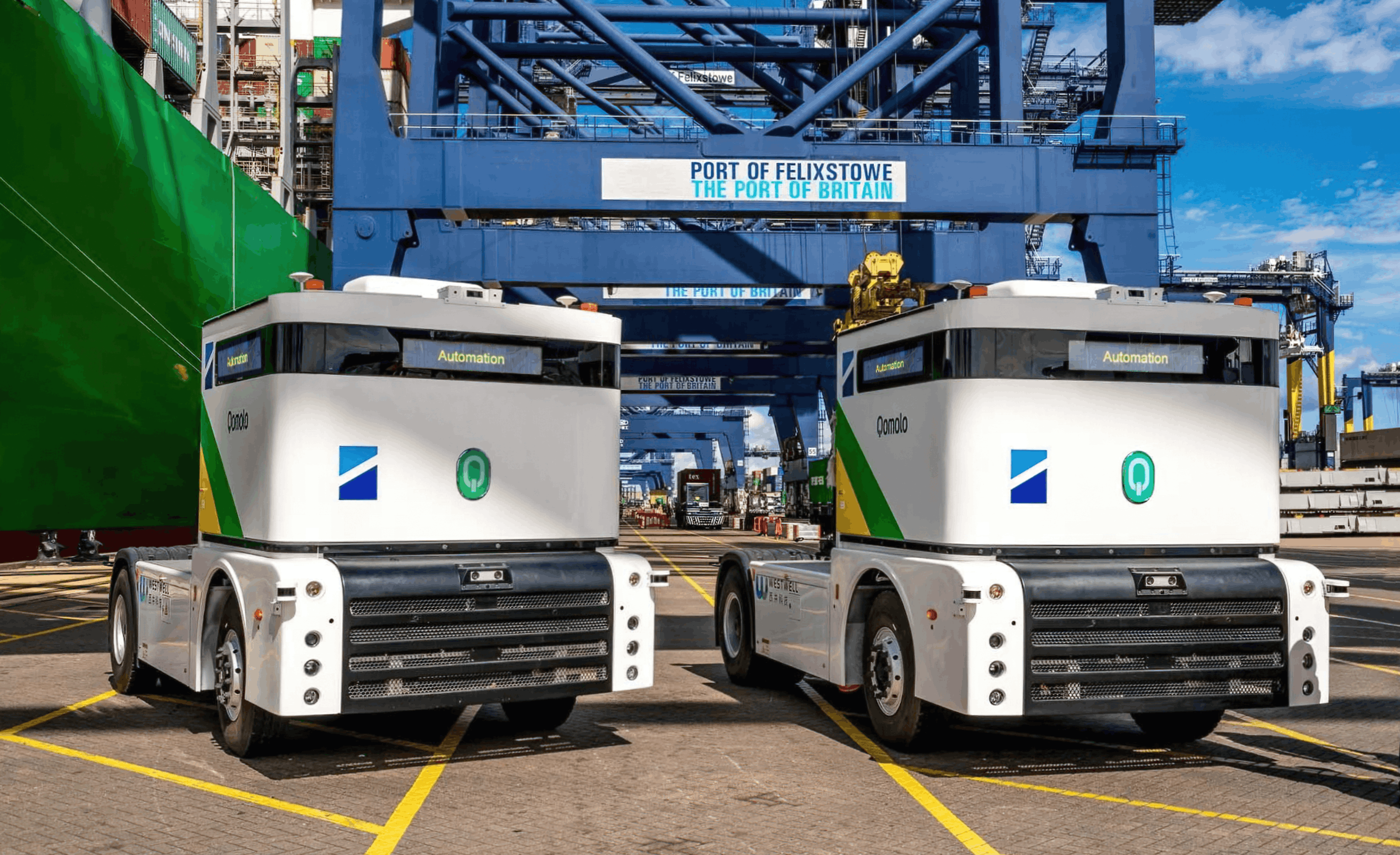
The Westwell Ainergy strategy is built on four principles:
What this means in practice: a terminal operator deploying Westwell Ainergy strategy does not acquire a truck and a charger. They receive a coordinated system in which every vehicle, every energy asset, and every scheduling decision is connected to a single intelligence layer — and optimized continuously against both throughput and carbon objectives.
What distinguishes Westwell Ainergy from competing green port technology offerings is not any single technology — it is the structured methodology by which the full solution is deployed.
Westwell's approach begins with a consulting-led energy planning engagement. Before equipment is specified or software is configured, Westwell maps the terminal's energy flows, throughput patterns, and carbon baseline. This top-down analysis produces a transformation plan that is technically validated — using WellSimtec, Westwell's digital twin simulation platform — before any physical deployment begins. The simulation validates feasibility, identifies resource conflicts, and projects performance outcomes before capital is committed.
From there, deployment proceeds in coordinated phases across three core capability domains:
| Capability Domain | What It Delivers |
| Equipment layer | Q-Truck and/or E-Truck fleets, PowerOnair battery swap infrastructure |
| Scheduling and orchestration layer | WellScheduler, WellFMS, WellRCMS and more— coordinating all vehicles, cranes, and assets |
| Energy management layer | WellEMS & AdaOps— integrating all energy sources, enabling demand response and carbon tracking |
Each layer is designed to function independently where necessary but produces significantly greater efficiency when integrated as a full stack.
TOC Europe 2026, taking place May 19–21 in Hamburg, convenes over 4,500 port technology professionals — from terminal operators and port authorities to equipment manufacturers and logistics technology providers. Green port automation, terminal electrification, and autonomous operations are central themes on the TECH TOC agenda.
The timing is not coincidental. Hamburg itself is one of Europe's most active maritime hubs. The EU ETS maritime extension is now fully in force. The IMO's decarbonization negotiations are entering a decisive phase at MEPC 84. And the competitive pressure among global terminal operators to demonstrate credible green transformation — not just sustainability reports, but operational results — has never been higher.
Westwell's participation in TOC Europe 2026 reflects a straightforward position: the technology to build a zero-carbon port, deployed at commercial scale, already exists. It has been proven at Laem Chabang, Abu Dhabi, Felixstowe, Chancay, and more. It is running in 50°C heat in the UAE, operating through EU port compliance requirements at Felixstowe, and operating at Laem Chabang under a fully customer-governed autonomous fleet model — where the terminal operator runs the fleet independently, without ongoing vendor-managed operations.
The question for terminal operators at TOC 2026 is not whether zero-carbon port operations are technically possible. The question is how quickly they can be designed, planned, and deployed — and which partner has the full-stack capability to deliver the architecture, not just the hardware.
A zero-carbon port is a container terminal that has eliminated or offset net greenhouse gas emissions from its horizontal transport, equipment operations, and energy consumption. In operational terms, this means replacing diesel-powered vehicles with battery-electric or fully autonomous electric alternatives, integrating renewable energy sources, deploying intelligent energy management to prevent waste and enable demand response, and continuously tracking carbon performance at the asset level. A fully zero-carbon port combines electric vehicle fleets, automated battery replenishment, predictive scheduling, and site-wide energy intelligence into a coordinated operational architecture.
Each battery-electric autonomous terminal tractor — such as Westwell's Q-Truck — eliminates the diesel combustion emissions associated with conventional yard tractors. Under green electricity scenarios (i.e., where the charging or battery swap energy source is renewable), a single Q-Truck reduces CO₂ emissions by up to 50 tonnes per vehicle per year. A fleet of 100 vehicles at a major port therefore represents the equivalent of removing approximately 5,000 tonnes of CO₂ annually. When paired with autonomous 24/7 operations (eliminating shift-change idle time and empty repositioning), the carbon efficiency advantage compounds against both manned diesel and manned electric alternatives.
A green port declaration is a policy commitment or certification indicating a port's intention to reduce its environmental footprint. Actual green port operations means the physical infrastructure — electric vehicle fleets, automated energy management, real-time carbon monitoring — is deployed and generating measurable results. The distinction matters because regulators, shipping lines, and cargo owners are increasingly demanding evidence of operational outcomes, not aspirational commitments. The metrics that count: CO₂ reduction per TEU handled, energy consumption per crane move, percentage of horizontal transport fleet electrified, and carbon per kWh of energy used. Westwell's Ainergy deployments are designed to generate these metrics from day one of commercial operations.
Yes. The Westwell Ainergy strategy is explicitly designed to accommodate both greenfield terminal development and intelligent upgrades to existing, operational ports. The consulting-led planning methodology identifies the most impactful intervention points for each terminal's specific layout, traffic patterns, and equipment mix.
E-Truck, for example, is designed for terminals transitioning from manned diesel fleets — it operates in human-driven mode immediately and upgrades to autonomous mode over time, protecting capital investment while enabling incremental decarbonization.
PowerOnair deploys via standard container transport with plug-and-play installation, making it deployable at existing terminals without major civil works. The modular architecture of the Ainergy stack means terminals can begin with the energy management layer, the vehicle layer, or both — and integrate them progressively.
The ports that will lead global container logistics in 2030 are being designed today. The regulatory pressure is clear. The commercial incentive is accelerating. And the technology — proven across ports in Asia, the Middle East, Europe, Latin America, and Africa — is ready for deployment.
Westwell 's Ainergy strategy represents a comprehensive answer to the most fundamental challenge facing terminal operators: how to achieve higher throughput and lower carbon output simultaneously, at commercial scale, with verifiable operational results.
The zero-carbon port is not a destination that terminals arrive at gradually through incremental purchases. It is an architecture that must be intentionally designed, coordinated, and deployed — with the right technology partner building it alongside you.
Ready to design your terminal's green transformation?
Request a conversation with Westwell's port decarbonization team