


In September 2022, the “AI Magic Box of 2022 World Artificial Intelligence Conference (WAIC): AI Smart Travel – Intelligent Driving” column aired live on the WAIC cloud platform and was simultaneously announced by CCTV and international hot news media. The program was hosted by Yuan Ming, the Chief Host of China DragonTV Official, and the participants included Kenny, Founder and CEO of Westwell, and Chen Long, CEO of WAYTOUS.
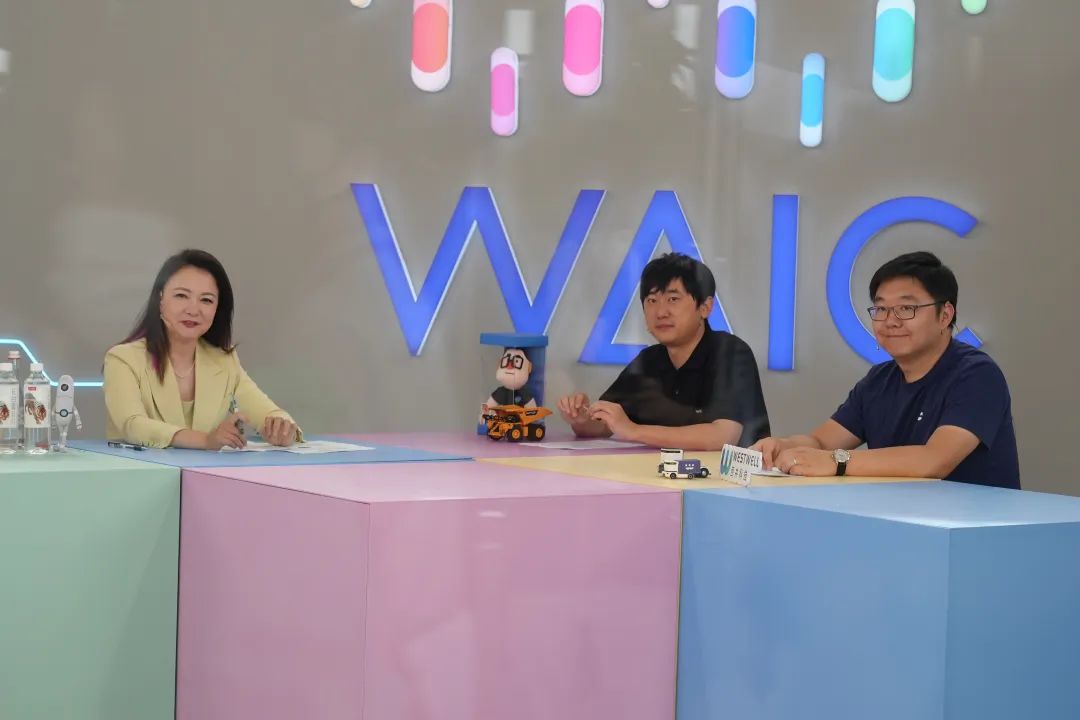
*From left to right: Yuan Ming, Chen Long, and Kenny
Based on the development of the artificial intelligence industry, this live broadcast focuses on green low-carbon, digital economy, metaverse, intelligent terminals, and other emerging industries to tap into new economic growth drivers and convey the impact of artificial intelligence enabling industries to the world. Topics discussed include how autonomous driving can achieve commercial success in specific segments and how it can contribute to reducing carbon emissions.
PART ONE
Yuan Ming: What does the Smart Port contain? What role does intelligent driving play in it?
Kenny: The Smart Port refers to operation nodes that used to be completed manually. We can realize digital operations and ensure standardized and consistent operations. This is because people's emotions and physical states vary every day, leading to different actual work outcomes under the same workload.
Consistent digital operation provides an ideal environment or basis for autonomous driving. For instance, when our vehicles and human operations engage in human-machine cooperation, much of the loss lies on the human side. However, if our vehicles cooperate with automated systems, operation efficiency can be further improved.
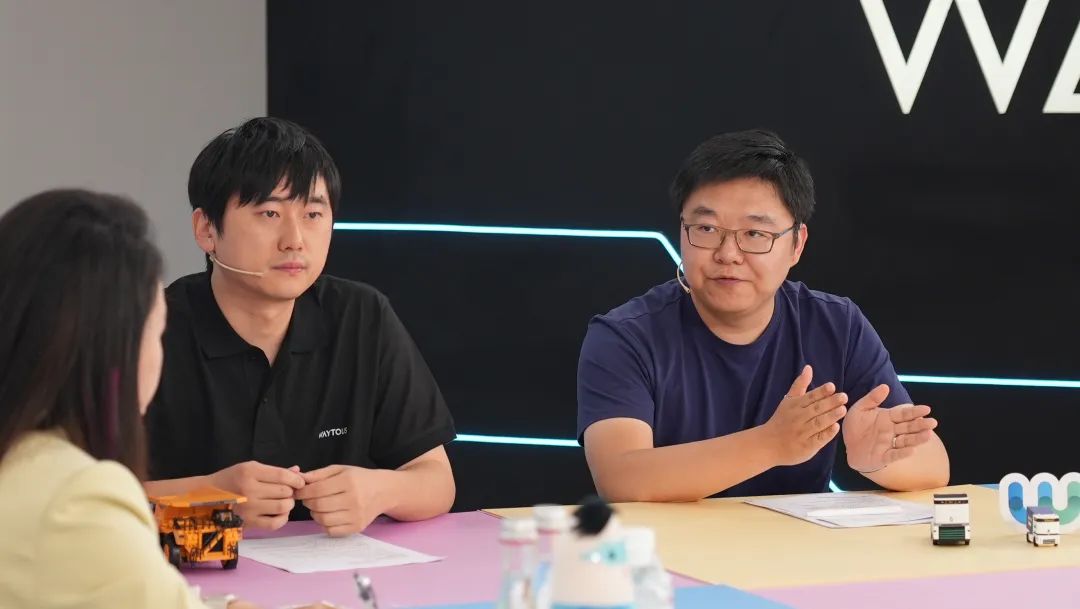
Vehicles are crucial in ports because they operate continuously on site. Each operation is linked with other operations at the same site. Through these, we integrate associated systems. We then address the problems of single-vehicle intelligence, efficiency, and safety. Simultaneously, all systems within the field are serially connected to form a collaborative and efficient system.
PART TWO
Yuan Ming: Will autonomous driving in ports be easier than on open roads?
Kenny: Different scenarios present various challenges. On open roads, we encounter many unforeseen emergencies and obstacles to avoid. Though ports might have fewer obstacles, we must consider the operation node and its associated difficulties.
Ports are full of metal containers and cranes, which greatly impact satellite positioning. Additionally, the final positioning accuracy of each operation must be within plus or minus two centimeters. Otherwise, the four locks at the corners of a container cannot align with the spreader, resulting in a failure to secure the container.

We need to ensure that vehicles and other equipment work together continuously and efficiently, and we must design optimal routes and efficient processes. This process must run incessantly. While intelligent driving is currently under discussion in the port industry, automated equipment has been in use since the 1980s in places like Rotterdam. This technique involves laying magnets on the ground for guidance, similar to the fourth phase of the Yangshan Port. Such an automation solution is more suitable for new terminals and ports, where the infrastructure can be established during construction. However, many ports are traditional terminals built in stock, and the need for automation today is just as urgent as it is for the new ones. Westwell's plan aims to help upgrade ports without requiring any infrastructural modifications.
PART THREE
Yuan Ming: What contribution does it make to global green and low carbon emissions? What is the space for imagination in the future?
Kenny: We believe that intelligence and electrification are mutually driven and inseparable. When it comes to autonomous driving, the control and other functions of diesel vehicles are not as precise and fast as electric vehicles in every aspect. Automobiles are developing towards green, low-carbon, new energy, and electrification, which significantly drives intelligence. The purchase cost of electric vehicles is much higher than that of traditional fuel vehicles, and the overall economic calculation would be challenging without automation or intelligent solutions to reduce part costs. With intelligence, the overall operating costs of a long life cycle can be reduced by decreasing manpower, making it easier for users to accept. Now, all the vehicles in Westwell are electrified. We have also calculated that an electric heavy truck can save 10.7 tons of carbon emissions a year. If one tree can handle roughly 4-18 kilograms of carbon a year, almost one vehicle is equivalent to more than 900 trees per year.


