

European container ports are under structural pressure. Throughput demands are rising, skilled labor is harder to retain, and decarbonization commitments are tightening — all at the same time. The most effective response emerging across global ports is not a single piece of equipment or a standalone software upgrade. It is the combination of AI-based dispatching systems working in real time with autonomous and intelligent electric vehicle fleets — coordinating every transport task, every energy replenishment cycle, and every vehicle route simultaneously, without human dispatchers managing the sequence manually.
This article explains how AI dispatching and autonomous vehicles work together in practice, what determines whether a port should deploy fully autonomous Q-Trucks or intelligent electric E-Trucks as the first step, and what the deployments at the Port of Felixstowe and Laem Chabang Port demonstrate for European operators evaluating the same transition.
Most European container ports do not have an equipment problem. They have a coordination problem.
A port running 20 cranes and 60 transport vehicles executes hundreds of interdependent micro-decisions per hour: which vehicle picks up which container, in which sequence, via which route, with energy replenishment scheduled at which point between tasks. When those decisions are made through static dispatch rules and human supervisors, gaps appear — vehicles queue at cranes because task sequencing has not updated in time, trucks idle waiting for instructions, and energy replenishment disrupts transport runs because charging is scheduled independently of task flow.
This coordination gap is well documented. A McKinsey & Company analysis of port automation found that even well-resourced terminals often see productivity fall by 7–15% in the early stages of automation — not because the technology fails, but because automation exposes the cost of fragmented systems: vehicles, cranes, yards, and energy managed in silos that cannot respond to each other in real time. The same analysis found that terminals which overcome this through full cross-functional integration can reduce operating expenses by 25–55% and increase productivity by 10–35% (McKinsey, 2018). The efficiency gain is not primarily from faster equipment. It is from eliminating the coordination lag between equipment, tasks, and energy — something conventional dispatch systems are structurally unable to do.
AI dispatching addresses this directly. It replaces static assignment rules with a real-time optimization engine that monitors all vehicles, tasks, yard states, crane schedules, and energy levels simultaneously, generating and updating dispatch sequences continuously as conditions change.
AI dispatching in a container terminal is a software system that uses machine learning to dynamically assign transport tasks, routes, and timing to all horizontal transport vehicles — continuously updating as terminal conditions shift.
AI dispatching does not wait for human input to respond to change. When a vessel arrives early, when a crane goes offline, or when two vehicles converge on the same route, the system recalculates and reassigns across the full fleet in real time.
But AI dispatching is only as effective as the vehicles it controls. A dispatching system sending optimized instructions to vehicles that cannot execute them precisely — or that require human confirmation at each step — absorbs the efficiency gain in the execution gap. This is why the dispatching layer and the vehicle layer are not separate product decisions. They are one system.
ReeWell by Westwell — the AI orchestration engine underlying its port deployments — integrates fleet management (WellFMS), AI dual-engine scheduling (WellScheduler), yard management (WellYMS), energy management (WellEMS) and more into a unified data layer. Vehicle routing decisions and energy replenishment scheduling are generated jointly — not sequentially. The dispatching system knows when each vehicle's battery state will require a swap, and factors that into task sequencing proactively, so no vehicle leaves a task queue to charge unexpectedly.
What makes this level of dispatching precision possible is the AI architecture operating beneath it. Westwell's Hymala World Model is a dual-world-model framework that connects individual vehicle intelligence with terminal-wide operational awareness into a single closed loop.
The first model operates at the vehicle level — processing sensor data from cameras, LiDAR, GNSS, and control systems to give each vehicle a continuous understanding of its immediate environment: what is ahead, what is changing, and how to respond safely in complex mixed-traffic conditions.
The second model operates at the terminal level — processing vehicle positions, task queues, road network load, yard pressure, resource availability, and energy states into a unified view of the full site. From this view, the system predicts where congestion will develop, where task load will peak, and where resource conflicts will emerge — and adjusts dispatch sequences before those problems materialize.
The critical design choice is the feedback loop between them. A single vehicle slowing, stopping, or rerouting — due to a pedestrian, a crane movement, or a tight corner — is not treated as an isolated event. It is mapped as a change in the terminal's global operational state, and the terminal model adjusts task sequences for all other vehicles accordingly. Conversely, when the terminal model predicts an approaching congestion zone, it influences individual vehicle routing and timing before the congestion forms.
This is what separates system-level intelligence from fleet-level automation. In a conventional automated terminal, vehicles execute pre-assigned tasks. In a Hymala-powered terminal, every vehicle is a dynamic node in a continuously self-correcting system — and every dispatch decision is informed by the full operational picture.
For terminals that have made the commitment to fully autonomous horizontal transport, Q-Truck is the vehicle the dispatching system controls directly.
Q-Truck is a cabless autonomous terminal tractor purpose-built for container logistics in enclosed port environments. The cabless design is not a cost reduction — it is an architectural decision that increases cargo flexibility, reduces vehicle footprint, and removes the operational constraints imposed by human occupancy: shift rotations, fatigue management, and the safety envelope around a driver's cab.
The dispatching interaction is direct. WellFMS assigns each equipment or vehicle a task — container pickup location, delivery point, and sequencing priority — while monitoring fleet position and operational status in real time. If a crane becomes available ahead of schedule, WellFMS updates the task sequence across the affected vehicles instantly. If a vehicle's battery approaches the swap threshold, AdaOps flags the state and coordinates with WellEMS to insert a replenishment slot between tasks — without interrupting the broader throughput sequence.
Q-Truck's on-board intelligence — built on Westwell's WellDrive autonomous driving system — handles the physical execution: ±3 cm positioning precision, sensor fusion across cameras and LiDAR, real-time obstacle avoidance, and centimetre-level container docking. The dispatching system handles operational logic. Together, they eliminate the operational delay at every stage of the transport cycle.
Not every European terminal is positioned to deploy a fully autonomous fleet immediately. Regulatory environments differ by country. Existing union agreements may govern driver roles. Terminal road networks may require validation before removing human oversight. These are not reasons to delay decarbonization — they are reasons to choose the right starting point.
E-Truck is Westwell's answer for this transition period. It is a manned smart electric heavy-duty truck with an L4-ready architecture — meaning it operates with a human driver today but is hardware-ready to upgrade to full autonomous driving when the terminal and regulatory context are prepared, without replacing the vehicle.
This matters because the decarbonization case does not wait for full autonomy. Every E-Truck operating on a port today reduces CO₂ emissions by up to 50 tonnes per vehicle annually under green electricity conditions — the same figure as a fully autonomous Q-Truck. Ports waiting for full autonomy before acting on carbon reduction are leaving measurable environmental performance on the table.
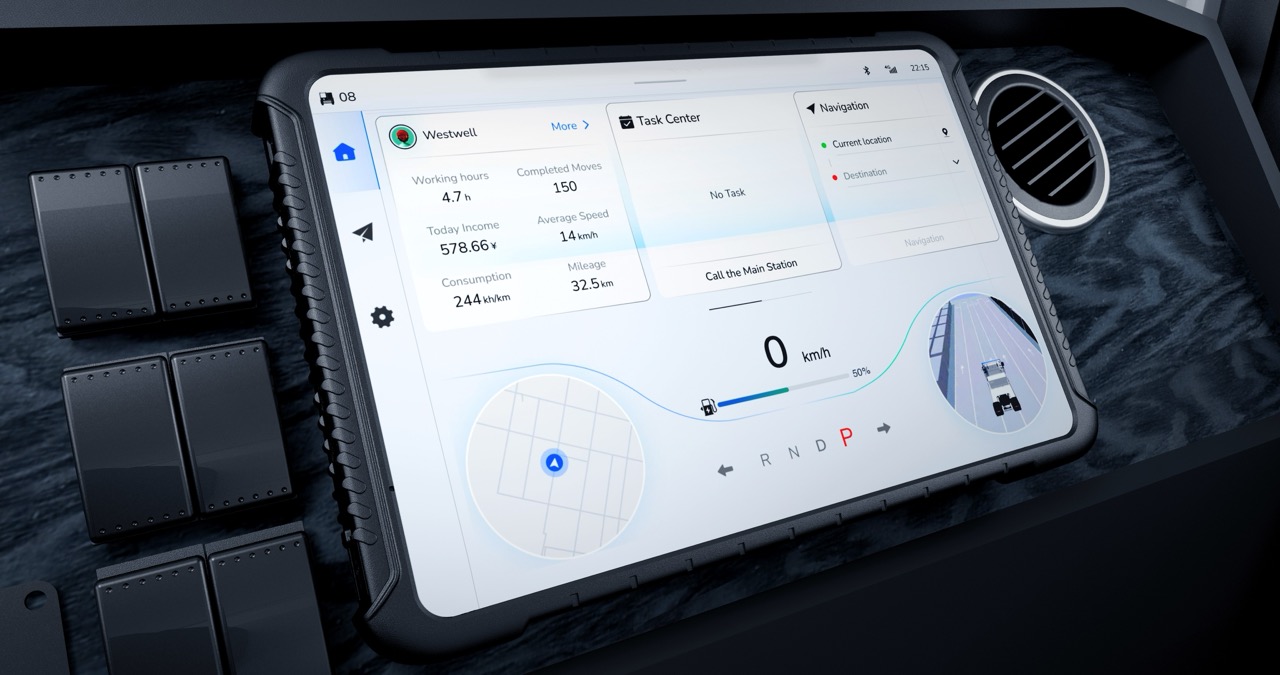
E-Truck is also fully integrated with the ReeWell platform from day one. Even with a human driver, WellFMS monitors the vehicle's position, task status, and energy state in real time. WellScheduler assigns tasks to E-Truck in the same dispatch queue as any autonomous vehicle on the site. This means a mixed fleet — some Q-Trucks operating autonomously, some E-Trucks with drivers — operates under a single dispatching system, without two parallel management structures.
When the port is ready to upgrade, E-Truck's E/E architecture supports the addition of the full autonomous driving sensor and compute stack. The vehicle does not need to be replaced — it is upgraded. The capital investment is protected across both stages of the deployment.
Operational outcomes:
To support long-term European operations, Westwell has established a UK spare parts hub, deployed resident engineers at the port, and is building a regional European subsidiary — ensuring full operational support within European time zones and regulatory frameworks.
The Felixstowe deployment is not a pilot. It is a production operation — and the largest autonomous electric commercial vehicle fleet at a European container port.
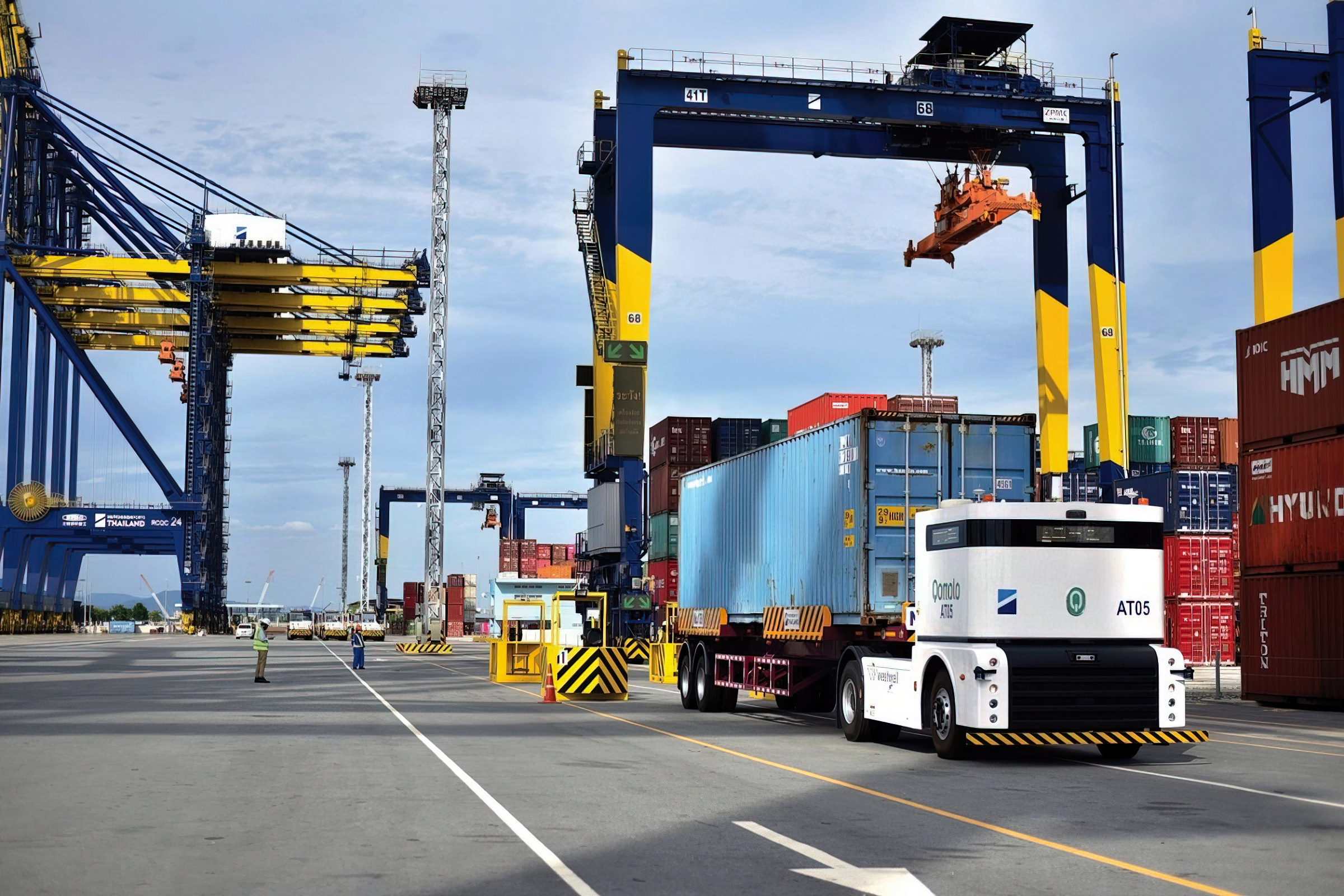
Laem Chabang Port in Thailand — the country's largest deep-water container port — provides the operational reference model that European terminals can examine before committing to their own deployments.
As of 2025, the Laem Chabang deployment has surpassed 750,000 TEUs of autonomous vehicle-assisted throughput. The full solution combines Q-Truck autonomous terminal tractors, E-Truck intelligent electric trucks, PowerOnair battery swap infrastructure, WellFMS fleet management, WellGate smart gate control, and WellSecurity real-time monitoring.
The defining contribution of Laem Chabang is the world-leading scalable mixed-fleet model — autonomous Q-Trucks and human-driven vehicles operating simultaneously in the same active terminal, managed by a single AI dispatching system, without physical separation barriers or magnetic guidance infrastructure. The dispatching system maintains full awareness of all vehicle positions and task states, coordinating routes and timing across autonomous and manned assets simultaneously.
For European terminals evaluating how to begin a transition without shutting down live operations, Laem Chabang demonstrates the answer: start with E-Trucks or a small Q-Truck cohort, run them in a mixed fleet under unified AI dispatching, and scale progressively as operational confidence builds.
The Felixstowe and Laem Chabang deployments share a common evaluation framework that European operators can use as a starting checklist:
| Evaluation Area | Key Question | What to Look For |
| Dispatching integration | Does the AI dispatching system connect to your existing TOS without replacing it? | Open integration layer; WellFMS and WellScheduler designed to work alongside existing port systems |
| Vehicle readiness | Is your terminal ready for full autonomy, or is a manned transition vehicle the right first step? | Q-Truck for full autonomy; E-Truck for L4-ready transition with immediate carbon impact |
| Energy infrastructure | Does your terminal have the infrastructure to support continuous electric fleet operations? | PowerOnair: modular, plug-and-play, sub-5-minute battery swap |
| Mixed-fleet operation | Can the system manage autonomous and manned vehicles on the same road network simultaneously? | Unified dispatch layer — no physical separation required, validated at Laem Chabang |
| Local support | Is there on-site engineering and spare parts support within European operational hours? | UK spare parts hub, resident engineers, planned European regional subsidiary |
| Carbon reporting | Can the system provide verified energy consumption and emissions data for ESG reporting? | WellEMS energy and carbon management — real-time monitoring across all fleet assets |
AI dispatching in a container terminal is a real-time optimization system that uses machine learning to dynamically assign and sequence transport tasks across the vehicle fleet, cranes, and yard equipment. AI dispatching continuously updates task assignments as terminal conditions change — responding to vessel schedule shifts, equipment states, congestion patterns, and energy levels simultaneously, without manual operator intervention between updates.
The AI dispatching system assigns each Q-Truck a task — container, pickup location, delivery point, and route — and monitors the vehicle's position, task completion, and battery state in real time. When conditions change (a crane becomes available early, a route becomes congested, or a battery approaches the swap threshold), the dispatch system updates the task sequence for that vehicle and all others in the fleet simultaneously. The Q-Truck executes the updated instruction autonomously, without any human confirmation step in the loop.
Q-Truck is a fully autonomous, cabless terminal tractor that operates without a human driver and is managed entirely by AI dispatching. E-Truck is a manned smart electric truck with an L4-ready architecture — it operates with a driver today but can be upgraded to full autonomous capability without replacing the vehicle. The right choice depends on terminal readiness: if regulatory approval and operational conditions support full autonomy, Q-Truck delivers maximum dispatching efficiency and 24/7 unmanned operations. If the port needs to decarbonize immediately while building toward autonomy, E-Truck delivers the same CO₂ reduction — up to 50 tonnes per vehicle annually under green electricity conditions — with a clear upgrade path to autonomous operation.
PowerOnair, Westwell's automated battery swap station, exchanges a depleted battery pack for a fully charged unit in under five minutes — without the vehicle leaving the operational zone. The swap is fully robotic: the vehicle enters the station, is automatically identified, and the battery exchange is completed without any manual steps. Swap timing is coordinated by WellEMS, which schedules replenishment between transport tasks to prevent queue formation.
Yes — this is precisely what the Laem Chabang mixed-fleet deployment demonstrates. Autonomous Q-Trucks and human-driven vehicles operate in the same active terminal simultaneously, coordinated by Westwell FMS dispatching system, without magnetic guidance tracks, physical separation barriers, or dedicated autonomous-only lanes. The dispatching system maintains real-time awareness of all vehicle positions and manages routing and timing across both fleets in the same decision layer.
European port automation is not a question of whether autonomous vehicles will arrive at terminals on this continent. They already have — at Felixstowe, operating at scale under live commercial conditions. The question for operators evaluating TOC Europe this year is which deployment path matches their terminal's current readiness and near-term objectives.
For terminals ready to move directly to full autonomy: Q-Truck, coordinated by AI dispatching, eliminates the delay across the entire horizontal transport cycle. For terminals prioritizing immediate carbon reduction while building toward full autonomy: E-Truck delivers the same emissions impact today, with hardware already prepared for the next step.
In both cases, the dispatching system is not a feature of the vehicle. It is the operational brain that makes the vehicle intelligent — at the level of the full terminal, not just the individual machine.
Westwell will be at TOC Europe. The team behind the Felixstowe and Laem Chabang deployments will be available to walk through what an AI dispatching and autonomous vehicle deployment would look like for your specific terminal profile.