


Airside decarbonization is the process of reducing greenhouse gas emissions from airport ground operations while keeping aircraft, baggage and cargo moving on schedule. Electric ground support equipment (eGSE) removes tailpipe emissions from individual vehicles, but fleet replacement is only one part of the job. A workable programme must also account for electricity supply, charging or battery swapping, vehicle availability, task scheduling and the systems that connect each operation.
For a busy cargo hub, these choices cannot be made in isolation. A tractor that is charging during the evening export peak is unavailable, however clean its powertrain may be. A fully charged autonomous vehicle still adds little value if dispatchers cannot see the next task, cargo status or congestion ahead. The practical objective is a coordinated operating system that cuts emissions without weakening throughput or resilience.
The airside is the security-controlled part of an airport used for aircraft movement and ground operations. It includes runways, taxiways, aprons, cargo handling areas and ground support equipment staging zones. For cargo operators, the relevant workflow may extend from an air cargo terminal or warehouse to an apron handover point, depending on the airport's operating boundary.
A "zero-carbon airside" is best treated as a defined operational goal, not as a label attached to an electric vehicle purchase. The airport or handler needs to state which emission sources and facilities are included, how purchased electricity is accounted for, and whether the claim refers to direct operations or a wider value chain. Without that boundary, zero-carbon claims are difficult to compare or verify.
Most airside decarbonization programmes involve some combination of:
The last two points matter because electrification changes the energy source, while operational control determines how much energy the site uses to complete the work.
Electric ground support equipment replaces an internal combustion engine with an electric drivetrain. In air cargo operations, this may include electric tow tractors, belt loaders, forklifts and other handling equipment. An autonomous cargo tractor adds perception, positioning, decision-making and vehicle control so it can execute assigned transport tasks with limited or no routine driving input.
The distinction is important. An electric tractor addresses tailpipe emissions and local noise. An autonomous electric tractor can also standardise route execution and reduce dependence on repetitive driving work. Neither capability decides which job should run next, whether a vehicle has enough energy for it, or how a delayed flight should change the plan. Those decisions sit above the vehicle.
Duty cycle should therefore lead equipment selection. Operators need to examine towing load, route length, surface conditions, congestion, temperature, shift pattern, coupling requirements and available energy windows. A range figure on a product sheet is useful, but it cannot replace a route-level assessment of how the tractor will work through a peak period.
An effective air cargo automation system has three connected layers. Each layer solves a different operational problem.
|
Layer |
Main function |
Typical inputs |
Operational question |
|
Electric and autonomous equipment |
Executes cargo, baggage and dolly movements |
Assigned task, route, load and safety rules |
Can the asset complete the move safely and consistently? |
|
Energy infrastructure |
Keeps the fleet available |
State of charge, electricity capacity, tariff, task windows |
When and where should each vehicle replenish energy? |
|
Fleet and site orchestration |
Coordinates work across the operation |
Flight plan, cargo status, vehicle location, traffic, battery level |
Which asset should take which task, and what changes when conditions shift? |
The equipment layer is where work happens. The energy layer protects vehicle availability. The orchestration layer turns flight, cargo, fleet and energy data into an executable plan.
This model becomes particularly useful during disruption. If a flight is delayed, the scheduler can defer associated cargo movements, release vehicles to other tasks and move energy replenishment into the new gap. If a charger or swap station becomes unavailable, the system can protect essential missions and redirect the affected vehicles. Operators keep control of exceptions instead of rebuilding the plan through radio calls and spreadsheets.
Energy planning deserves early attention. Airports Council International has warned that electrification of airport systems and ground support equipment could raise electricity demand at large hub airports by five to ten times by mid-century. That forecast covers more than today's tractor fleet, but it shows why grid capacity and clean power planning need to sit inside the airside decarbonization programme from the beginning.
Battery swapping can be useful where vehicles have narrow task gaps and plug-in charging would remove too much capacity from the fleet. It is not automatically the right answer for every asset. The choice depends on battery standardisation, fleet size, utilisation, site layout, capital cost and the electricity connection available at the chosen location.
High-throughput airports provide a demanding test for this model. Hong Kong International Airport (HKIA) handled 5.07 million tonnes of cargo in 2025 and ranked as the world's busiest cargo airport for the 15th time since 2010, according to Airport Authority Hong Kong. At that scale, vehicle availability and transfer timing are operating constraints, not secondary engineering details.
In 2025, Westwell announced an agreement to deploy customised Q-Tractors at HKIA for baggage and cargo handling. The published configuration used a 116.5 kWh battery and stated a range of 200 km, along with 360-degree perception and centimetre-level docking accuracy. The value of those specifications depends on how they fit the airport's routes, load profile and turnaround plan. The HKIA Q-Tractor deployment announcement provides the equipment context.
Hong Kong Air Cargo Terminals Limited (Hactl) presents a different operating environment. Its SuperTerminal 1 has an annual handling capacity of up to 3.5 million tonnes, according to Hactl's facts and figures. Westwell and Hactl have been working on the use of Q-Tractor P40 for cargo dolly towing, including the technical challenge of automatically coupling and uncoupling dollies with different specifications. This is a useful example of why airport automation has to account for physical interfaces as well as navigation. The Hactl collaboration announcement describes the development scope without treating a pilot as a fully scaled result.
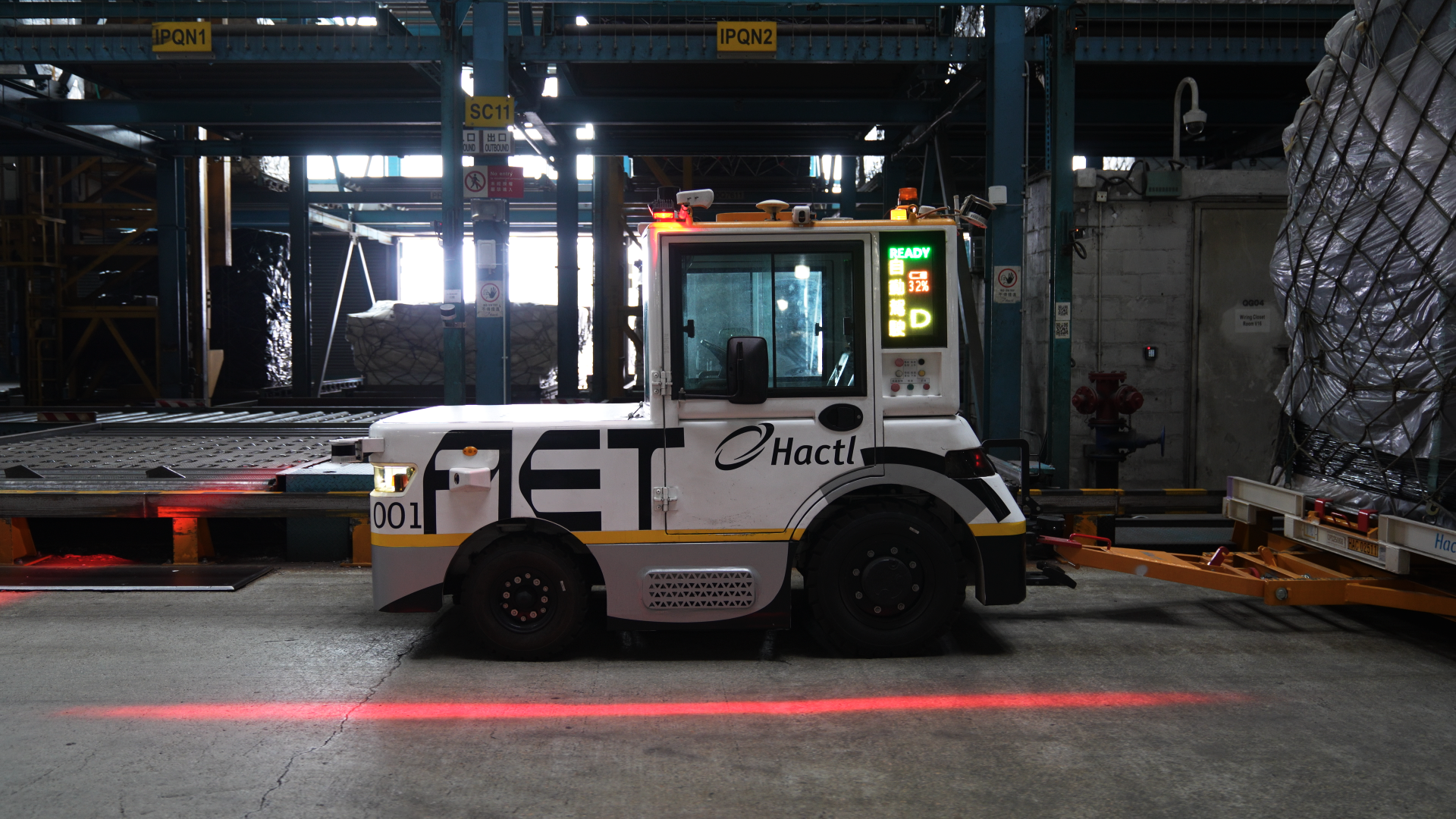
Energy replenishment is another part of the equipment decision. Westwell's published Q-Tractor P40 Plus configuration combines a 200 km range with a five-minute battery swap option for high-frequency transport work. These figures describe a product configuration, not a guaranteed duty cycle at every airport. Operators still need to validate usable range, swap frequency and battery inventory against their own task data. See the Q-Tractor P40 Plus specification context.
Define the routes, equipment classes, facilities and emission sources included in the programme. Record current fuel and electricity use, task volume, labour model, peak windows and service failures. This baseline gives the team a way to test whether the new operation is cleaner and whether it performs better.
A suitable first route is repetitive enough to measure, operationally meaningful, and contained enough to manage safely. The constraint might be diesel exposure inside a cargo facility, unreliable staffing on a night shift, excessive empty tractor travel, or charging downtime during a peak bank. Choosing a specific constraint prevents the pilot from becoming a technology demonstration with no operational owner.
Document every handover between the cargo system, dispatcher, vehicle, dolly, energy system and safety team. Check hitch types, load limits, geofenced areas, mixed-traffic rules, communications coverage and recovery procedures. For autonomous equipment, the exception process matters as much as the nominal route.
Use actual task timestamps and load data to estimate energy consumption, charging or swapping windows, spare vehicle requirements and peak electrical demand. Compare plug-in charging, opportunity charging and battery swapping on the same duty-cycle assumptions. The result should show how many tasks the fleet can complete, rather than stopping at battery replenishment time.
Before live dispatch, the scheduling layer can run alongside the existing process and compare proposed decisions with actual outcomes. Controlled operations can then test route compliance, coupling, obstacle response, communications loss and manual recovery. Set acceptance thresholds before the trial starts so that progress is judged against operating evidence.
Scaling may mean adding vehicles to the same route, connecting a second cargo zone, or coordinating more equipment classes. Each step adds interactions. Expand after the team has stable data, a documented exception process and enough energy capacity for the next stage.
Emission reduction and operational performance should be reviewed together. A useful dashboard can include:
|
Metric |
What it reveals |
|
Task completion rate within the required window |
Whether automation protects the service plan |
|
Vehicle availability during peak periods |
Whether charging, swapping and maintenance fit the duty cycle |
|
Empty distance per completed task |
Whether dispatch reduces avoidable movement |
|
Energy use per task, tonne or ULD moved |
Whether the operation is becoming more energy efficient |
|
Manual interventions per operating hour |
Where autonomy or process design still needs work |
|
Coupling success rate and time |
Whether vehicle and dolly interfaces are reliable |
|
Safety events and recovery time |
Whether the operating model handles exceptions safely |
|
Carbon dioxide equivalent by defined scope |
Whether the programme delivers against its stated boundary |
These metrics also make pilots easier to compare. A vehicle can complete a route successfully while the wider operation loses time through handovers, charging queues or manual recovery. Looking at the full workflow prevents a local improvement from hiding a system-level cost.
Westwell approaches airport logistics through two connected layers. Physical AI covers on-site execution, including autonomous electric vehicles and energy equipment. Operational AI coordinates tasks, fleet status, traffic and energy data across the site.
For airport cargo operations, Q-Tractor provides the autonomous towing capability. ReeWell provides the orchestration layer that connects tasks, equipment, people, sites and energy data. The technology still has to be configured around each airport's systems, rules and duty cycles. The purpose of the combined architecture is to give operators one plan for movement and energy instead of separate vehicle and charging decisions.
Teams evaluating this approach can review Westwell's smart airport logistics solution alongside their own route data, electrical capacity and safety requirements.
Airside decarbonization reduces greenhouse gas emissions from airport ground operations. It may include electric ground support equipment, cleaner electricity, fixed ground power, more efficient dispatch and operational changes that reduce idling or empty travel. The programme needs a stated accounting boundary so that results can be measured consistently.
No single equipment change can establish that claim. eGSE removes tailpipe emissions from the vehicle, but the result also depends on the electricity source, fixed facilities, fleet utilisation and the emission sources included in the airport's boundary. Operators need energy data and a defined carbon accounting method.
An autonomous cargo tractor can execute repetitive towing tasks, follow assigned routes and, where the vehicle and dolly interfaces support it, automate coupling and uncoupling. It becomes part of a wider air cargo automation system when task, cargo, flight and fleet data feed a common dispatch process.
Battery swapping is most relevant when vehicles run at high utilisation and have task gaps too short for plug-in charging. The business case depends on fleet scale, battery compatibility, available space, grid connection, maintenance model and the cost of spare batteries and swap equipment.
Measure task completion, peak-period availability, empty travel, energy use, manual interventions, interface reliability, safety events and recovery time. Compare each result with the pre-pilot baseline. This shows whether the project improves the whole operating process rather than a single vehicle movement.
Airside decarbonization works best when the airport treats vehicles, energy and dispatch as one operating problem. The first step does not have to cover the entire airside. Choose a route where emissions, downtime or manual coordination are already constraining the operation, establish the baseline, and test whether a connected system improves that specific workflow. The evidence from that route can then guide the next stage of investment.
.jpg?x-oss-process=image/format,webp/quality,q_100&v=1.0.0)


