Introduction
Robot as a Service in ground handling (RaaS) is a pay-per-use model for autonomous ground support equipment (GSE): the vendor supplies and maintains the vehicles, and the Ground Handling Agent pays by trip, by operating hour, or through a monthly volume package. An owned autonomous fleet is the opposite approach: the GHA purchases the vehicles outright, builds or contracts an in-house dispatch and orchestration layer, and retains full control of assets and data.
The choice between these two models is a capex vs opex decision at its foundation, but it extends into questions of operational control, data ownership, and long-term strategic positioning. High-throughput, stable hub operations tend to favour ownership, where long-term unit economics improve with utilisation. Light-asset, high-volatility stations and regional GHAs gain more from the flexibility of RaaS.
Three overlapping pressures are pushing this decision to the top of the agenda. First,
global air cargo volumes reached a record 127 million metric tonnes in 2024, up 9.9% year on year according to Airports Council International (ACI World, 2025 Dataset). Second, the labour gap in ground handling keeps widening: according to an IATA survey presented at the 35th IATA Ground Handling Conference (May 2023), 37% of ground handling professionals anticipated staffing shortages persisting beyond 2023, and 60% reported insufficient qualified staff for smooth operations. Third, aviation crew and ground staff costs have been climbing steadily, with BCG's Air Travel Outlook (February 2026) reporting crew cost increases of 5% to 7% year on year across Europe and North America in 2025.
What RaaS Means in Ground Handling (and why it's rising)
RaaS is a delivery model where a vendor supplies autonomous vehicles, round-the-clock maintenance, over-the-air software upgrades, and on-site technical support as a bundled service. The GHA pays per trip, per mile, or via a monthly volume package, with no requirement to purchase the vehicles or bear technology iteration risk.
Three factors explain why adoption is accelerating. First, it requires zero upfront capital, converting a large equipment purchase into predictable operating expenditure that scales with business volume. Second, it enables faster project rollout: established vendors can complete vehicle deployment and scenario adaptation within weeks, responding to temporary capacity surges such as holiday peaks or charter programmes. Third, vendors take full responsibility for hardware upkeep, algorithm updates, and regulatory compliance throughout the contract term, so GHAs do not need to build dedicated in-house autonomous vehicle engineering teams.
The broader RaaS model across all industries is growing rapidly. The Business Research Company (2026) valued the global Robotics as a Service market at $32.08 billion in 2026, growing at a 20.1% CAGR. Within aviation, the shift toward subscription and pay-per-use equipment models is visible in the general GSE market as well: ground handling wage inflation has averaged 7% to 12% annually in key markets since 2022 (MarketIntelo, Ground Handling Services Market Research Report, 2026), intensifying the financial case for models that reduce fixed headcount commitments.
What "Owning an Integrated Autonomous Fleet" Actually Means
An owned autonomous fleet is not simply buying vehicles for in-house use. It is a system with three components: a self-owned fleet of
autonomous cargo tractors and other GSE, an enterprise-controlled dispatch and orchestration layer, and (optionally) vendor-managed on-site maintenance.
The core differentiator is not asset ownership but deep integration capability and data ownership. An owned fleet can be integrated at the system level with the GHA's existing flight management system, warehouse management system, and ground service dispatch platform, allowing customised operation rules, route planning, and shift scheduling. All operational data, driving trajectories, and efficiency metrics are stored and controlled by the enterprise, enabling continuous process optimisation. GHAs that opt for vendor-managed maintenance still retain ownership of both assets and data, outsourcing only routine upkeep.
Total Cost of Ownership (TCO) is the standard framework for comparing the two models. TCO accounts for the full cost of an asset from acquisition through operation to disposal, including purchase price, charging infrastructure, annual maintenance, battery degradation, and residual value at end of life. For electric autonomous tractors specifically, CALSTART's 2024 fleet electrification study found that battery-electric truck components retain 15% to 25% of initial vehicle value at Year 5 (CALSTART, "Financing Fleet Electrification: Battery-Electric Truck Component Resale Highlights Residual Value Upside," September 2024).
This residual value is better than the near-zero assumptions many lenders currently use, which means the long-term economics of ownership may be stronger than initial financing terms suggest.
RaaS vs. Owned Integrated Fleets: The Comparison
The table below outlines the core differences, framed around the capex vs opex tradeoff:
| Dimension |
RaaS (Leased Fleet) |
Owned Integrated Fleet |
| Upfront cost |
Zero capital outlay; opex only |
Significant capex for vehicles, charging infrastructure, and system integration |
| Payment structure |
Per trip, per hour, or monthly package |
Depreciation over 5-8 year asset life |
| Fleet scaling |
Add or reduce vehicles within weeks |
Fixed fleet size; expansion requires new procurement cycle |
| Utilisation risk |
Vendor absorbs idle capacity cost |
GHA bears full cost of underutilised vehicles |
| System integration |
Standard API interfaces; limited customisation |
Deep integration with flight, warehouse, and dispatch systems |
| Data ownership |
Vendor retains operational data; GHA accesses via standard reports |
GHA owns and controls all operational data |
| Technology upgrades |
Included in service contract (OTA updates, hardware refresh) |
GHA funds sensor upgrades and software iterations |
| Maintenance |
Vendor-managed, 24/7 on-site support |
In-house team or contracted vendor; GHA manages relationship |
| 5-year TCO (high utilisation, >70%) |
Higher total spend over full term |
Lower unit cost; economics improve with each year of stable operation |
| 5-year TCO (low utilisation, <60%) |
Lower total spend due to no idle cost |
Higher unit cost; fixed costs not offset by volume |
| Contract exit |
Return vehicles at contract end |
Residual value at disposal; resale or vendor buyback |
Beyond the table, the decision hinges on four key dimensions:
Scaling economics. RaaS suits multi-station rollout where speed matters more than per-unit cost. Ownership pays off at high-throughput single sites where utilisation dilutes the fixed investment.
Apron customisation. Owned fleets allow algorithm tuning for site-specific conditions (tunnel navigation, narrow passages, non-standard stand layouts). RaaS typically ships a standardised configuration, with bespoke adaptation available at added cost.
Data and orchestration. Ownership gives the GHA full control of operational data and the ability to embed fleet dispatch into its own flight and warehouse systems. RaaS provides standard interface access only.
Long-term cost trajectory. Over a 5-year cycle with utilisation above 70%, ownership tends to deliver lower total cost. Below 3 years or with volatile traffic, RaaS avoids stranded-asset risk. Each GHA should model this with its own data.
How Air Cargo Hubs Are Deploying This in Practice
From a commercial deployment perspective, Westwell‘s autonomous cargo tractor solutions are operational at several major air cargo nodes.
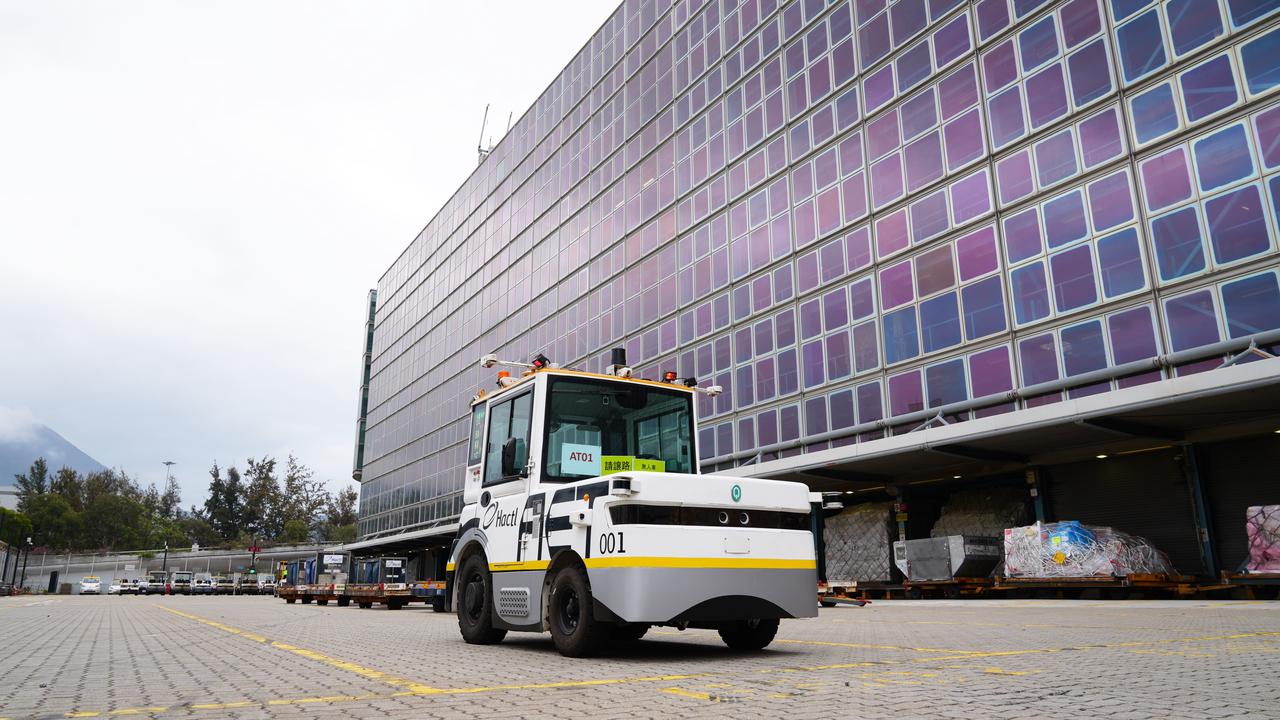
Fuzhou Changle International Airport and Xiamen Xiang'an International Airport: Westwell secured new deployment projects at both airports, covering cargo transfer operations between cargo terminals and apron staging areas.
A common feature of these projects is that they are deeply adapted to the specific operation routes of cargo hubs — such as narrow-passage navigation inside cargo terminals, stable positioning in tunnel environments and process handover at intermodal nodes — rather than generic equipment deployment, ultimately delivering improvements in both operation efficiency and stability of airport ground handling technology.
What Different Types of GHAs Are Choosing
Major global GHA groups are adopting hybrid strategies. Core hub airports maintain owned fleets to accumulate operational data and build deep automation capability. Outsourced or short-contract stations use RaaS for rapid deployment without capital commitment. Several large groups have established dedicated automation asset management functions to optimise the ratio between the two models.
Regional GHAs lean more heavily toward RaaS. Capital constraints and revenue volatility make pay-per-use models a better match for cash flow. These operators also benefit from transferring maintenance and technology upgrade responsibility to the vendor.
Cargo and express operators with in-house ground handling are beginning to test joint-operation models, where the vendor retains vehicle ownership and maintenance responsibility while the cargo operator manages dispatch and on-site workflow. Both parties share technology and operational risk.
FAQ
Is RaaS cheaper than owning autonomous GSE outright?
It depends on utilisation and operating cycle. For stations with high flight volatility, annual utilisation below 60%, and an operating horizon shorter than 3 years, RaaS typically delivers lower total cost by eliminating idle capacity charges and asset depreciation risk. For high-throughput hubs with stable, long-term operations, TCO analysis based on general electric commercial vehicle economics suggests ownership costs are meaningfully lower over a 5-year period. GHAs should model both scenarios using their most recent 12 months of flight and baggage data.
Can autonomous cargo tractors operate safely on aprons with mixed human and vehicle traffic?
Current commercial-grade solutions support mixed-traffic apron environments. Vehicles such as Westwell's Q-Tractor use multi-sensor fusion (GNSS, HD cameras, LiDAR) for 360-degree environmental perception, identifying obstacles including pedestrians, human-driven GSE, and ground support personnel. They feature active obstacle avoidance, speed reduction, emergency stop capability, and dynamic route planning, adapted to variable lighting and weather conditions on the apron.
What is the difference between RaaS and a fleet orchestration platform?
RaaS is a bundled delivery model combining assets and services: the GHA gets ready-to-use autonomous capacity without owning the vehicles. A fleet orchestration platform is a dispatch and data management system, typically paired with an owned fleet. Its value lies in global capacity coordination, data accumulation, and deep integration with the GHA's business systems. The two can coexist: some GHAs use RaaS vehicles managed through their own orchestration layer.
Does a Ground Handling Agent need to own its own orchestration software?
Not necessarily. For single outsourced stations handling basic operations, standard dispatch tools bundled with RaaS are sufficient. For large GHAs operating across multiple sites that treat automation as a core capability, owning orchestration software enables cross-station coordination, proprietary data accumulation, and continuous optimisation of fleet performance.
Conclusion
Looking ahead, as air cargo throughput continues to grow and airport ground handling technology matures, the core logic of industry selection is gradually shifting toward “control + deep integration”. The capex vs opex tradeoff remains the foundational consideration for most GHAs, but hybrid strategies are becoming the industry norm: core hubs build long-term competitive barriers with owned fleets of autonomous ground handling equipment led by the autonomous cargo tractor, while edge stations and flexible capacity rely on robot as a service ground handling / RaaS for light-asset supplementation.
The value of automated ground services ultimately boils down to tangible improvements in efficiency, cost and stability. For a deeper understanding of the capability framework of integrated fleet orchestration platforms and the full range of autonomous ground support equipment solutions, you can refer to deployed hub-level project cases for further evaluation.



.jpg?x-oss-process=image/format,webp/quality,q_100&v=1.0.0)


