


Wang didn't go back to his hometown for the Chinese New Year this year. This native, who a few years ago had complained about the fatigue and danger of driving heavy trucks, is now a test engineer for Westwell's autonomous driving vehicles. In the past couple of years, Wang has frequently traveled abroad. Due to the severity of the global pandemic, he and six other programmers and engineers spent a Chinese New Year in Laem Chabang Port, Thailand, without their families, but not alone.
Translating their Experience into Specific Parameters for Programmers
At an age of 41, Wang has held a premier Class A driver's license for 20 years. In the industry, a Class A license is often referred to as an "omnipotent license" with downward compatibility, meaning "aside from aircraft and tanks, essentially any road vehicle can be driven," Wang explains. Today, obtaining a Class A license has become an increasingly difficult feat. Starting from a Class C license, it would take a series of driving grade tests spanning seven to eight years to achieve a Class A license.
Despite possessing these valuable skills, Wang's work involved considerable risk. In 2015, he bought a truck to transport freight short distances among Jiangsu, Zhejiang, and Shanghai. His earnings fluctuated based on his physical strength. As long as his health allowed, Wang would keep driving. During this period, he ran his truck day and night. At his busiest, aside from assembly time, he drove for more than 20 hours straight. He feared falling asleep on the road, so he often munched on sunflower seeds, smoked, and drank cold water to stay awake. "Still, there were always a few seconds when I felt as if I had dozed off and woke up again... I don't like to imagine what could have happened during those moments..."
Wang drove over 300,000 kilometers in roughly a year and a half without a single accident. However, he frequently heard grim news of his colleagues getting into accidents. This led to an undeniable sense that this line of work was unsustainable, so he made the tough decision to rent out his truck and open a small automobile parts store in Shanghai.
In the summer of 2017, when business was slow, a fellow townsman approached Wang with news that a Shanghai technology company was seeking part-time heavy truck drivers to test autonomous driving vehicles. On hearing this, Wang thought, "That sounds exciting!" With a sudden surge of enthusiasm, he pursued the opportunity. The company, known as Westwell, remembered Wang. A truck was stranded at the site because no one else held a Class A license to move it.
For the first time in his life, Wang felt genuinely sought after.
More rewarding experiences were yet to come. The coding engineers would ask for highly specific details like, "How far should you slow down before braking? How forcefully should you apply brakes? When should you start turning the steering wheel before pulling into the garage? How much should you turn the wheel to ensure the rear trailer of the truck straightens out?"
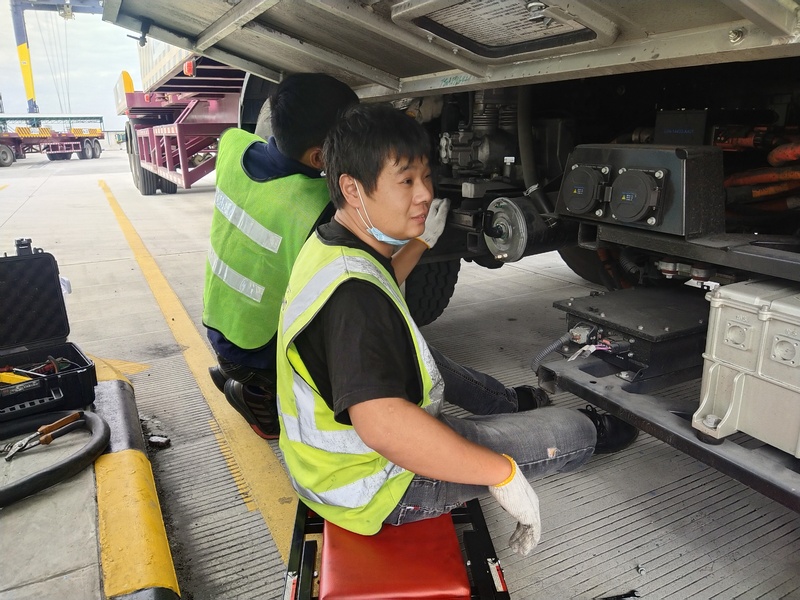
(Photo) Wang and his colleagues are working on the maintenance of self-driving vehicles at the terminal
As a driver, Wang had an innate sense of these measures. However, when faced with such detailed questions from the AI company, he realized the importance of accurately quantifying measurements, like degrees of deceleration or acceleration, brake intensity, and turning angles. These details were then converted into specific parameters for the programmers' codes and tested on site in Zhuhai Port and Shenzhen Yantian Port.
Even before Wang joined Westwell in 2016, this burgeoning AI company began directing its application scenarios towards ports. Problems they aimed to address included high-intensity full-load work for truck drivers, rising container volumes outpacing available manpower, and high labor costs causing bottlenecks in distribution and transportation. As the routes from the port terminals to the yard are fixed, self-driving vehicles operating across three shifts could ultimately replace manned trucks. This would help ports confront challenges like recruitment, expensive labor, and fatigue driving while ensuring and potentially increasing overall throughput efficiency.
Autonomous Driving: Liberating Humans from Dangerous and Hard Work
ng assisted programmers at Zhuhai Port and Shenzhen Yantian Port in carrying out real-world tests. Given the varying conditions found on terminal roadways, reliable Wang always took the helm, driving a few rounds to assess the situation. The programmers would then adapt his advice into coding language, allowing the truck to further its self-driving capabilities. Wang was floored, saying, "Artificial intelligence is truly impressive". However, the programmers responded with, "Old Wang is sharper" – his advice paved the way for autonomous vehicles to achieve 80% of the performance of human-controlled vehicles.
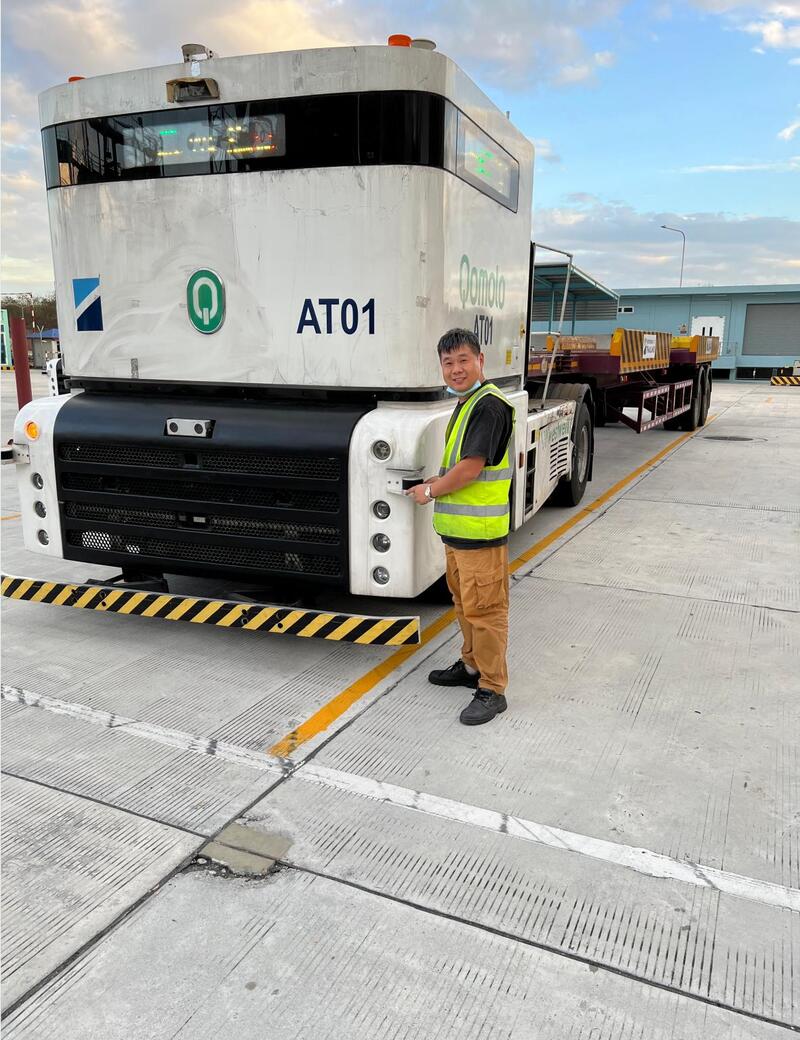
(Photo) Wang at the port
Asked if he ever miscalculated, Wang assured the journalist, "Never". In collaboration with the R&D team, the debugging process was rigorous and iterative, allowing him to witness the evolution of Westwell's autonomous vehicles from phase 0 to 1. "Now, the autonomous driving experience is more standardised than human driving," Wang reports. In September 2018, Westwell officially introduced Q-Truck, a new species in autonomous driving vehicles, first deployed at Chinese ports.
From 2020 onwards, the COVID-19 pandemic has caused severe shortages in global port machine operators and truck drivers, resulting in significant congestion in port areas. The pandemic has consequently disrupted logistics and supply chains, intensifying the demand for "automated, intelligent, remote and lean" management in global terminal operations. This has spurred the international growth of Westwell. The Q-Truck fleet has been deployed in commercial operations at Laem Chabang Port in Thailand and Khalifa Port in Abu Dhabi, UAE. With over 100 sets of autonomous driving products delivered to ports worldwide, Westwell Technology continues to advance, with the global debut of intelligent battery swap autonomous driving commercial vehicle Q-Truck set for mass production this year.
In January this year, Westwell announced the mass production of the global first intelligent battery swap self-driving commercial vehicle Q-Truck.
Moreover, seasoned drivers like Wang contribute significantly to this rapid growth. During WeChat voice interviews, Wang often incorporates English words such as 'bypass', 'cut in', etc. Prior to joining Westwell, he had never travelled abroad. Now, he finds himself in Thailand for this Spring Festival, with potential future travel to ports in the United Arab Emirates, Malaysia, and other locations. Just like Westwell's rapid development, Wang is continually transferring his wisdom to increasingly intelligent autonomous drivin vehicles.
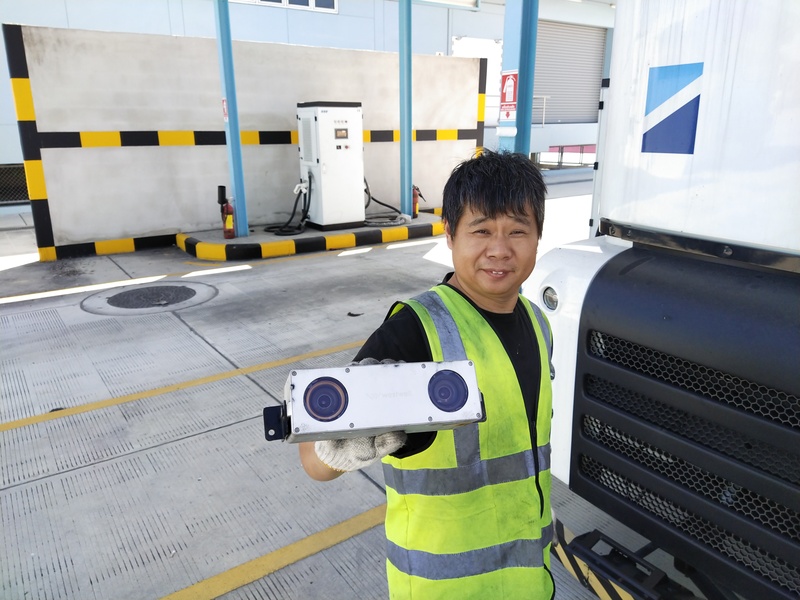
(Photo) Wang holds an industrial binocular AI camera for Q-Truck.
As a seasoned driver-turned-test-master, Wang extols his career transformation, saying, "It's a choice of the times. This advancement serves to increase safety, thus freeing humans from dangerous and challenging tasks."
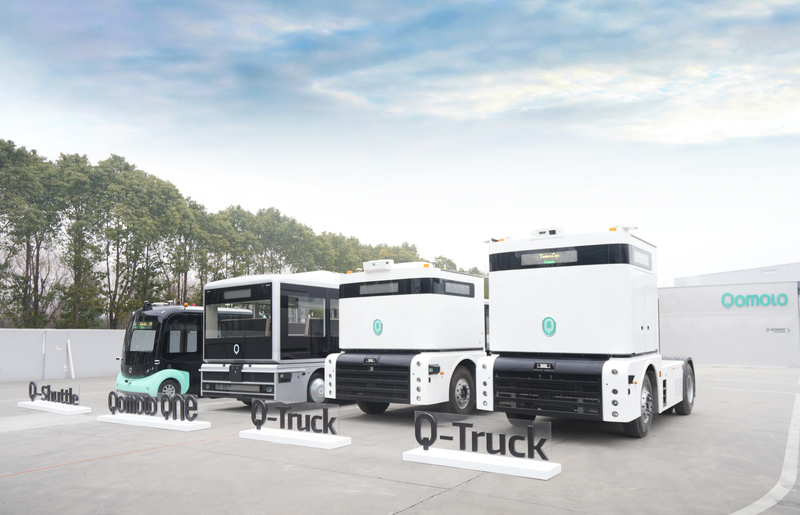
(Photo) Westwell's autonomous driving products have been delivered to more than 100 ports worldwide.


