


Products
Industries
LinkAige
About


European ports operate at the intersection of growing cargo demand, strict safety requirements, and ambitious sustainability targets. These pressures aren’t problems—they are natural outcomes of busy terminals built on decades of maritime heritage and layered operational systems.
As ports look for ways to enhance efficiency and reduce emissions without disrupting ongoing work, flexible automation has become an increasingly practical path forward. Full-stack AI logistics solutions, such as those deployed by Westwell, are designed to complement existing infrastructure, support mixed traffic operations, and strengthen safety and environmental performance.
The recent collaboration at the Port of Felixstowe shows how intelligent, adaptable technologies can integrate seamlessly into real port conditions—helping European terminals unlock smoother, safer, and more sustainable operations.
European ports carry more than cargo—they carry history. Many of the region’s busiest terminals, including the Port of Felixstowe, operate on infrastructure shaped long before automation or autonomous logistics were ever imagined. Narrow roadways, legacy yard layouts, and dense traffic patterns make it difficult to introduce rigid, monolithic technologies without major reconstruction.
At the same time, these ports must balance several non-negotiable pressures:
This is why European port operations require automation that adapts to the environment, not technology that forces the environment to change. In this context, Westwell’s approach stands out. Rooted in a philosophy of “From Human to Human” Westwell integrates autonomous driving, AI-powered perception, and fleet management systems into existing workflows to enhance—not disrupt—daily port scheduling.
At Port of Felixstowe, this has meant enabling real-world performance of autonomous trucks in a complex, mixed-traffic environment where Westwell Q-Trucks must coordinate with manned vehicles, unpredictable weather, and historically constrained layouts. The result demonstrates how autonomous logistics in Europe can be deployed safely and sustainably while honoring local regulations and operational culture.
This groundwork sets the stage for the next shift: why modular, flexible systems are outperforming traditional, all-or-nothing automation models across modern sustainable ports.
Westwell’s Ainergy strategy—AI + New Energy—is designed for exactly the kind of operational complexity seen at the Port of Felixstowe. Instead of imposing a fixed automation model, Westwell’s modular approach allows autonomous logistics systems to integrate with existing port operations, infrastructure, and safety protocols. This is where intelligent driving, fleet coordination, and clean energy converge to prove what next-generation port operations can look like in Europe.
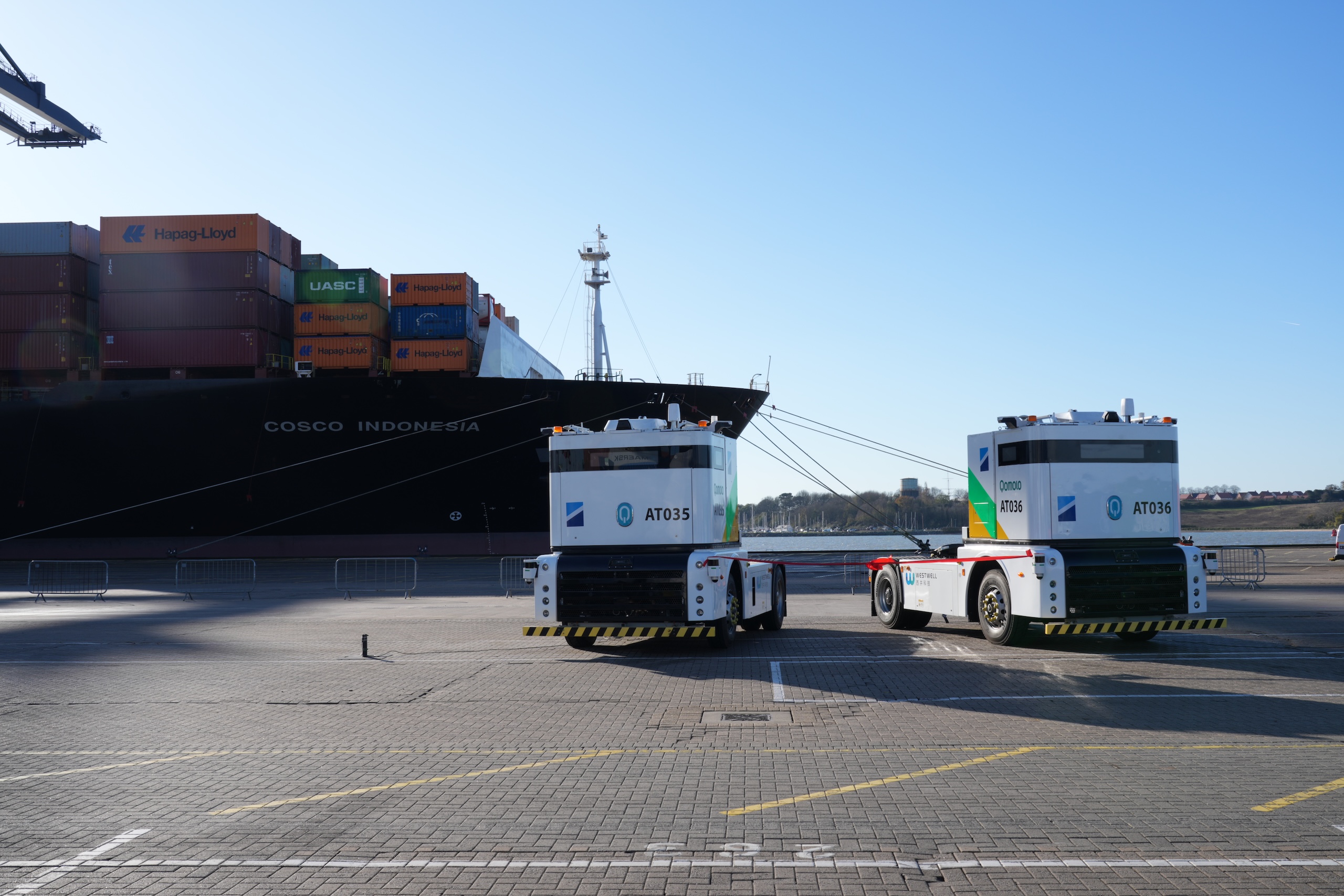
At the Port of Felixstowe, Westwell’s modular automation has delivered one of Europe’s first real examples of autonomous trucks operating safely in mixed traffic—not in isolated test sites, but alongside manned trucks, terminal tractors, and everyday port movements. This is where intelligent driving meets real-world complexity.
Each Q-Truck uses advanced sensor fusion and clear visual/audible signals to communicate intentions, ensuring predictable interactions with human drivers. Coordinated through the WellFMS fleet management system, autonomous and manned fleets work together without disrupting existing workflows.
The deployment is now scaling with the arrival of a second batch of autonomous trucks, establishing Felixstowe as a leading case in autonomous logistics and demonstrating why Westwell’s flexible, AI-powered approach fits Europe’s operational and regulatory environment.
At Port of Felixstowe, efficiency comes from more than autonomous driving—it comes from systems working together. Westwell’s AI-driven WellFMS works alongside the port’s existing operations, coordinating vehicles, tasks, and routes in real time. This removes delays and keep workflows steady even during peak activity.
Q-Trucks maintain stable performance across narrow roadways, tight turns, and densely stacked container areas, ensuring continuous operation rather than stop-and-go cycles. Energy replenishment is no longer a bottleneck: automated battery swapping, completed in under five minutes, allows trucks to return to work almost immediately. The result is truly 24/7 logistics capability, maximizing throughput and productivity without altering existing port practices.
For European ports seeking measurable progress toward sustainability goals, Westwell’s new-energy framework delivers immediate environmental impact. At Felixstowe, the Westwell PowerOnair automated battery-swap station ensures that autonomous trucks operate on clean electric power throughout the day. A depleted battery can be replaced with a fully charged one in five to six minutes, eliminating diesel emissions and enabling continuous zero-emission operations.
This aligns with the broader sustainability vision outlined in Westwell’s Freight Logistics Decarbonization Whitepaper, which emphasizes modular electrification as a practical pathway for ports that cannot afford large-scale infrastructure rebuilds. The combination of AI-driven fleet optimization and low-carbon energy systems demonstrates how autonomous trucking can help Europe’s century-old ports transition toward sustainable, high-performance port operations while maintaining operational continuity.
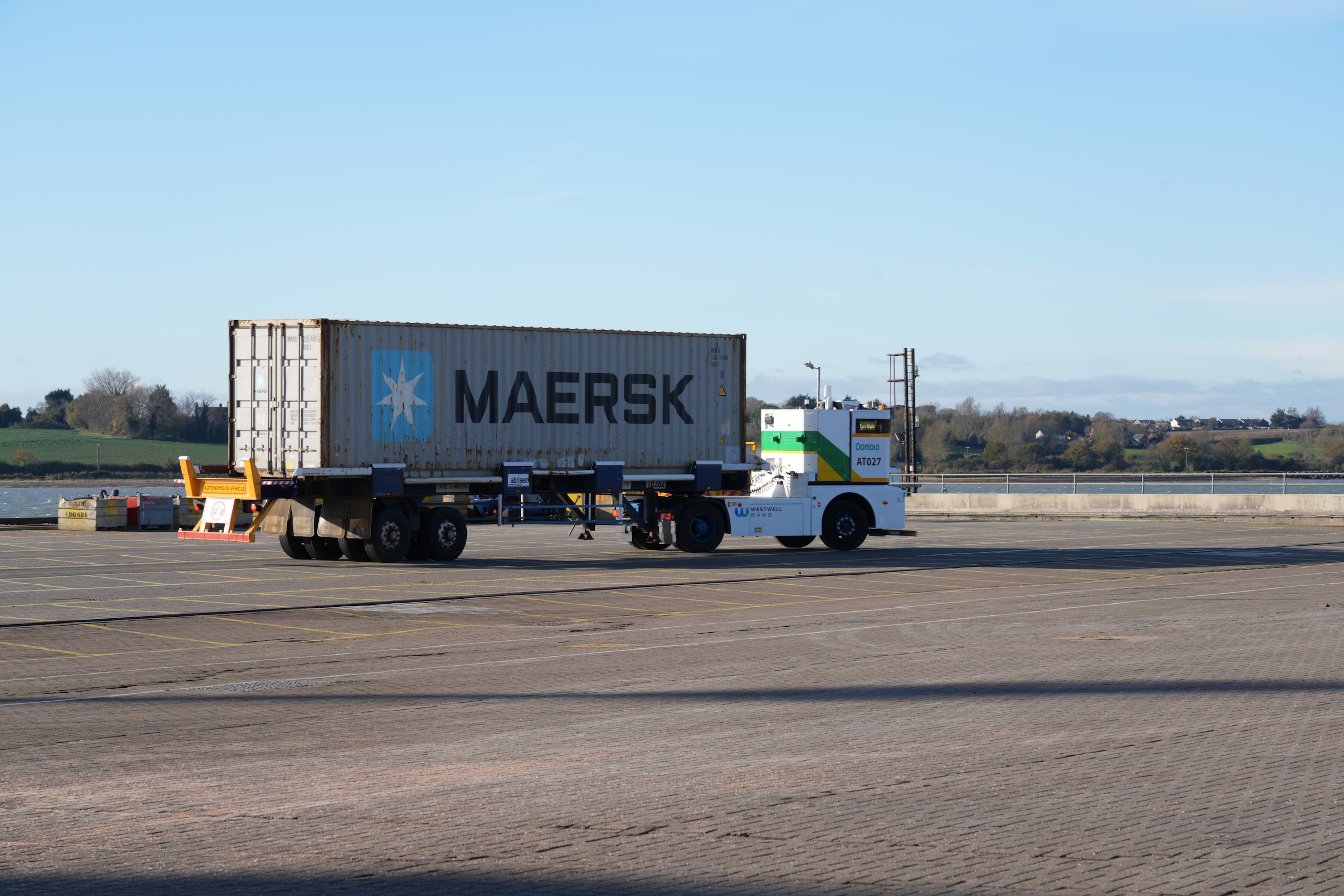
Westwell’s autonomous logistics solutions have been successfully deployed across 28+ countries and regions, serving 200+ clients, proving the adaptability and scalability of its modular, AI-driven approach.
At Laem Chabang Port in Thailand, Westwell’s Q-Trucks have transformed operations in a full-scale closed scenario. Leveraging high-precision navigation and efficient fleet coordination, the deployment enables mixed operations alongside human-driven terminal trucks. This allows traditional ports to achieve low-cost, intelligent automation, continuously generating real commercial value from autonomous trucks.
In Abu Dhabi, Westwell introduced a commercialized autonomous truck operation model to support autonomous, zero-contact terminal operations. This approach not only mitigates risks from human congestion but also delivers long-term benefits including cost reduction, efficiency gains, enhanced safety, and environmental sustainability. Using AI-as-a-Service (AIaaS), ports can quickly adopt autonomous operations with minimal disruption, leveraging digital capabilities and innovation to modernize traditional supply chains and strengthen operational competitiveness.
The Port of Felixstowe illustrates how Westwell’s modular automation and Ainergy strategy (AI + New Energy) turn cutting-edge technology into practical, reliable operations. Autonomous trucks navigate complex environments, coexist safely with human operators, and maintain efficiency 24/7—all while reducing emissions and operational risks.
Through its SMART methodology, Westwell continues to transform port operations globally, proving that innovation, flexibility, and sustainable practices can coexist with traditional workflows. The result is a future where ports are not only more efficient and safer but also environmentally responsible—unlocking real-world value today while preparing for the next chapter of global logistics.