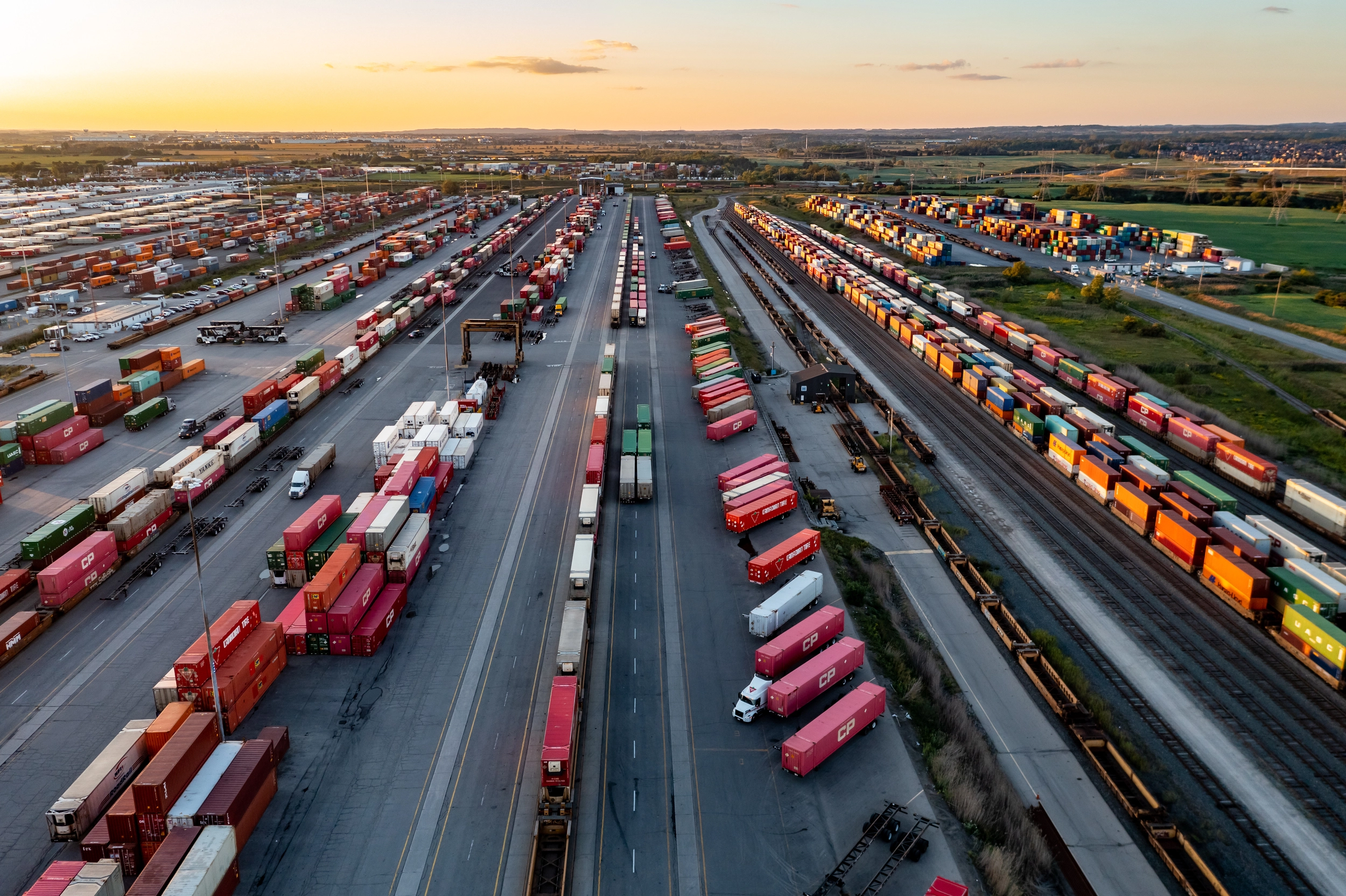


Autonomous trucks can work beside human drivers in an active terminal. The condition is not a separate autonomous lane. It is a shared operating model: one dispatching authority, visible vehicle intent, site-specific traffic rules and a tested process for recovering tasks when the plan changes.
That distinction becomes clear the moment a normal shift stops being normal. A lane closes around a quay-crane hand-off. A manually driven tractor arrives late. An autonomous truck pauses after detecting an obstacle. Containers still need to reach the next operation, and the dispatcher must decide which task moves, waits or changes route. Mixed-fleet operations succeed when that decision is made through agreed rules rather than radio calls and improvisation.
This is how Westwell approaches mixed traffic in live terminals: autonomous driving handles repeatable, coordination-heavy transport work, while human drivers remain part of the operating model. The objective is not to remove people from the terminal. It is to give people, vehicles and systems a predictable way to work through change.
A controlled route can show that an autonomous truck can perceive its surroundings, follow a map and complete a transport task. A live terminal asks harder questions. Vessel sequences move. Equipment becomes unavailable. A driver may take a route that is operationally sensible in the moment but not represented in a static plan. Roads, transfer points and work zones are shared by people with different ways of interpreting the same situation.
Human drivers use eye contact, hand signals, radio messages and local knowledge. An autonomous truck follows its assigned task, its safety boundaries and the rules available to the system. Neither approach is inherently better. The problem begins when the terminal has not made those behaviours legible to one another.
For Westwell, the mixed-fleet question is therefore not whether an autonomous truck can drive next to a human-driven vehicle. It is whether every participant can anticipate what happens when priorities, routes or conditions change.

Predictability is operational, not abstract. A driver approaching an intersection needs to know whether an autonomous vehicle will continue, yield or wait. A dispatcher needs to know whether a stopped vehicle has paused safely, lost a task, or created a conflict that will affect crane and yard resources. The system needs to recognise the same task status that the people on site are acting on.
| Operating question | What human drivers need to know | What the terminal operating model must provide |
| Who has priority? | When to yield and when to proceed | Site-specific right-of-way rules that apply to human-driven and autonomous vehicles |
| What will the vehicle do next? | Whether it will stop, turn, dock or wait | Visible operating state and clear driving intent through approved HMI, lighting or site mechanisms |
| What happens during an exception? | Whether to stop, reroute or await instruction | A defined escalation path, task-recovery workflow and named decision authority |
| Who controls the task? | Whether dispatch has changed the plan | One source of task status and route authority across the fleet |
| How is congestion managed? | Which routes remain usable | Current route availability, queue awareness and conflict management that reach dispatch and the field |
When these answers vary by vehicle type, shift or individual judgment, mixed traffic becomes slow and difficult to scale. When they are explicit, drivers can work around autonomous equipment without guessing, and autonomous equipment can respond without creating a new layer of coordination work.
The controls below are not a universal operating procedure. They are the items a terminal should settle before moving from a demonstration route into live mixed traffic.
|
Operating control |
What it changes in day-to-day work |
What to test before expansion |
|
One dispatching authority |
Manual and autonomous vehicles receive tasks from the same priority logic, instead of competing between separate plans |
A task change reaches the driver, vehicle and dispatch screen without conflicting instructions |
|
Defined right-of-way |
Junctions, crane approaches, transfer points and restricted areas have rules that people can apply consistently |
Drivers, equipment operators and autonomous vehicles respond consistently during busy periods |
|
Visible vehicle intent |
People nearby can see whether the vehicle is working, yielding, stopped, awaiting recovery or leaving service |
HMI, lights, displays or voice prompts are understood during day, night and poor-visibility operations |
|
Driver induction and refreshers |
Human drivers know safe passing, no-go areas, emergency reporting and actions that are prohibited around autonomous vehicles |
Contractors and visitors receive the same guidance as directly employed drivers |
|
Exception management |
Obstacle detection, blocked routes, low battery, communications loss and equipment faults become managed operating events |
The team can recover a task during a real shift without relying on an engineer to make each decision |
|
Near-miss learning loop |
Repeated hesitation points, informal workarounds and ambiguous rules are recorded before they become normal practice |
Reviews lead to a change in route design, rule, training or task logic, with ownership and a completion date | |
Fleet management matters here because it connects the vehicle event to the operating consequence. A low battery is not only a vehicle alert if it removes the only available tractor from a high-priority hand-off. A blocked lane is not only a traffic incident if it leaves containers waiting under a crane. The system has to show who and what will be affected, then give the terminal an agreed way to act.
The fastest way to make a mixed fleet unpredictable is to let informal workarounds become the operating model. Each of the practices below should be assessed against the terminal’s own safety and labour arrangements, but the underlying principle is consistent: do not ask people or vehicles to negotiate a critical operating rule in real time.
|
Prohibited practice |
Why it creates a problem in live operations |
|
Running manual and autonomous fleets under separate dispatch logic |
The two fleets can pursue conflicting priorities, routes and hand-off times without either dispatcher seeing the full conflict |
|
Informal right-of-way negotiation around autonomous vehicles |
Drivers cannot reliably predict whether a vehicle will yield, continue or wait; the system cannot learn from an unwritten rule |
|
Asking drivers to “work around” a stopped autonomous truck without a defined procedure |
A recovery event can become an unsafe manoeuvre in an active traffic or lifting area |
|
Scaling fleet size before testing peak and disruption workflows |
A normal-shift POC does not prove that the terminal can recover when cranes, roads, energy or schedules change |
|
Treating charging or battery swapping as separate from dispatch |
Vehicles can leave service during the same high-demand window in which the terminal needs them most |
|
Assuming drivers can infer vehicle state without approved HMI |
Hesitation, misinterpretation and unnecessary radio traffic increase when a vehicle’s next action is unclear |
The purpose of these rules is not to make a terminal less flexible. It is to preserve the flexibility that matters: the ability to reassign work safely when the original plan no longer fits the conditions on the ground.
Hutchison Ports Thailand’s 2024 Sustainability Report recorded 9 autonomous trucks operating in mixed traffic alongside manual trucks at Laem Chabang, with more than 410,000 container moves completed by the end of 2024. Today, the deployment includes 15 Q-Trucks, 9 E-Trucks, PowerOnair battery-swapping infrastructure and intelligent logistics systems. The project did not treat human-driven vehicles as a temporary inconvenience before full automation. It required autonomous and human-driven equipment to work in the same commercial environment, under a shared operating model.
The operating lesson is more useful than the vehicle count. Adding autonomous trucks changes how a terminal handles task authority, route conflict, energy availability and recovery from disruption. Those operating questions have to be resolved while the terminal continues to serve vessels and move containers, not after a technology demonstration ends.
Westwell’s Laem Chabang case record reports more than 750,000 TEUs processed by the deployment as of 2025. It also describes Q-Trucks and E-Trucks working in the same terminal under ReeWell coordination, without magnetic guidance tracks or physical autonomous-only lane separation. The important point for other terminals is not to copy that vehicle mix or throughput figure. It is to test whether their own task rules, road network, energy plan and recovery process can support mixed operation under real workload.
A mixed fleet cannot be made safe by a vehicle alone, and it cannot be managed by a dashboard that is disconnected from what happens on the road. Westwell combines vehicle, fleet, site and energy capabilities so that the same task can be understood by the truck, dispatcher and field team.
|
Operating layer |
Westwell role in a mixed fleet |
Why it matters during a live shift |
|
Vehicle layer |
Q-Truck provides autonomous electric container transport; manned electric vehicles can remain part of the operating mix |
The terminal can apply different vehicle types to the work they are suited to, without creating a separate operating language |
|
Perception and vehicle control |
The autonomous vehicle detects the road environment and applies its defined safety response |
A vehicle event becomes visible and manageable before it is treated as a generic “vehicle failure” |
|
Fleet and site coordination |
ReeWell connects task status, vehicle availability, routes and operational resources |
Dispatch can assess the effect of a change across the task chain rather than reacting to isolated alerts |
|
Energy layer |
PowerOnair places charging and battery swapping inside the vehicle-energy-road-cloud model |
Energy replenishment can be planned around workload and vehicle availability rather than becoming an unplanned loss of capacity |
Technology does not remove the need for terminal operating rules. It gives those rules a way to be executed consistently. The terminal still decides who owns the exception, which routes are acceptable and when human judgment must take over.
European terminals often need to introduce autonomy while existing traffic, contractors and equipment remain in service. In 2025, the Port of Felixstowe confirmed an additional order of 34 autonomous trucks, moving its programme from an initial mixed-traffic introduction toward a larger operating fleet. That transition is where workforce induction, route design, rule clarity and staged validation must be treated as deployment work, not post-launch communications.
For any European terminal, EU-level vehicle requirements do not replace the local traffic rules, labour arrangements and terminal safety procedures that govern a particular site. The first design question is therefore practical: which rules can the existing workforce recognise and apply consistently from the first live shift?
In the Middle East, terminal expansion can bring new roads, equipment and contractor teams into service at the same time. That increases the importance of assigning task authority before operations scale. At CSP Abu Dhabi Terminal, the autonomous transport programme has expanded alongside yard-equipment upgrades, quay expansion and dedicated network construction. The project update records 12 additional Q-Trucks entering operation in the first half of 2025, a six-unit Q-Chassis IGV expansion. The operating lesson is that vehicle deployment, road conditions, energy planning and system integration have to be assessed together.
APAC terminals often have to introduce autonomous equipment into dense, established operating environments rather than build a new terminal around it. In April 2026, Hongkong International Terminals launched its first autonomous-truck fleet, designed to operate alongside conventional vehicles in mixed traffic. The operator also identified future e-trucks and battery-swapping infrastructure as part of its wider terminal transition.
For operators in the region, the useful lesson is not that one vehicle type replaces another. It is that the first deployment has to work with existing road users, task systems and operating habits from day one. The more constrained the live environment, the more important it is to define vehicle intent, driver education and task recovery before fleet numbers increase.
A POC should prove more than a truck’s ability to complete a prescribed route. It should show whether the terminal can maintain control when the route, task sequence or available capacity changes.
Human drivers and autonomous trucks do not need separate terminals. They need one operational language, one decision layer and a shared understanding of what happens when the plan changes. That is the basis on which mixed-fleet operations become safer, more legible and ready to scale.
Yes. Safe mixed-fleet operation requires shared dispatch authority, site-specific right-of-way rules, visible vehicle intent, driver training and tested exception recovery.
It is an operating model in which autonomous and human-driven vehicles share tasks, roads, equipment interfaces and safety responsibilities. The fleet must work from consistent task status and traffic rules, even when the vehicle types differ.
The terminal should define right-of-way by location, task and operating condition, not by whether a vehicle has a driver. These rules must be documented, communicated and validated through the site’s own risk assessment.
A POC may show that a vehicle can complete a route under controlled conditions. Scaling requires the terminal to manage blocked roads, changed priorities, energy constraints, human intervention and task recovery during live operations.
Fleet management gives dispatch a shared view of task priority, vehicle availability, route conditions and work queues. It can then manage the consequences of a disruption across the task chain instead of treating each vehicle alert as an isolated event.
It should test shared dispatch, right-of-way, driver understanding of vehicle intent, exception escalation, energy planning and recovery during peak and disrupted shifts. The terminal should expand only after these controls work consistently in its own operating environment.